



A system can undergo strong fluctuations without losing its organization. A collaboration involving the SPHYNX group at SPEC (a joint CEA-CNRS research unit), Soochow University, the Max Planck Institute for Dynamics and Self-Organization (MPIDS), and Laboratoire Charles Coulomb (CNRS/Université de Montpellier) shows that the celebrated topological phase transition of the XY model, central to the 2016 Nobel Prize in Physics, is delayed beyond the limits known at equilibrium when the fluctuations experienced by the spins persist over time.
How can locally aligning elements remain organized when their orientations fluctuate strongly? At equilibrium, the XY model describes neighbouring orientations that tend to align. In two dimensions, this alignment is never perfect over long distances: orientations remain correlated, but their similarity gradually decreases. When fluctuations become too strong, defects proliferate and order disappears through a transition known as the Berezinskii-Kosterlitz-Thouless (BKT) transition. In this setting, the rate at which correlations decay provides a criterion for locating the transition. Yet earlier work on active crystals had revealed very large deformations without melting, a behaviour that cannot be interpreted directly using this equilibrium criterion.
Building on insights gained from studying crystals made of active particles (see highlight), the challenge was to determine whether the persistence in time of the perturbations could, on its own, produce strong fluctuations without a loss of order, and how it would affect the transition. To isolate this effect, the researchers revisited the XY model, replacing instantaneous fluctuations with time-correlated noise. This simplified model allows them to examine orientations and defects separately, using theoretical analysis and numerical simulations.
In the regime where defects are absent or rare, the calculations predict that orientational fluctuations can become much stronger than at equilibrium. The simulations confirm this prediction: correlations between orientations decay faster than they could in an ordered equilibrium phase, while the system retains quasi-long-range order. Orientations remain correlated over long distances, even though their similarity gradually decreases. The longer the perturbations persist, the more pronounced this difference can become. A rapid decay of correlations is therefore not enough to conclude that the system has lost its order.
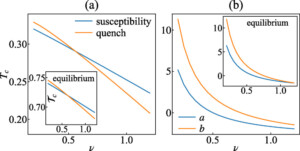
The next question was how the system eventually loses its order. Near the transition, defects become numerous, and the analysis that applies when they are rare is no longer sufficient. The researchers therefore compared another theoretical approach with several numerical measurements: changes in collective order, its susceptibility to fluctuations, and its relaxation over time. Taken together, the results are consistent with a BKT-type transition. Two scaling exponents that characterize its properties nevertheless vary with the persistence time of the perturbations. The transition thus occurs in a regime where correlations decay faster than the usual equilibrium threshold would allow. The authors note that a complete quantitative description of this transition remains to be developed.
This study shows that, out of equilibrium, a system can undergo strong fluctuations while retaining a degree of organization. When perturbations persist over time, correlations can decay faster than the equilibrium bound allows, and this bound no longer determines when order is lost. This result helps explain why active crystals can deform substantially without melting and opens a route to investigating their melting, as well as that of passive crystals subjected to an active environment. More broadly, it highlights that understanding the stability of a system out of equilibrium requires considering not only the strength of the perturbations, but also how long they persist. How this persistence affects the transition to disorder remains to be established for each system.
Reference
XY Model with Persistent Noise.
Xia-qing Shi, Hugues Chaté, Benoît Mahault. Phys. Rev. Lett. 136, 088302 (2026).
Collaboration
- University of Soochow, China.
- Institute Max-Planck for Dynamics and Self-Organization (MPIDS), Germany.
- Charles Coulomb Laboratory (CNRS-Montpellier University).