

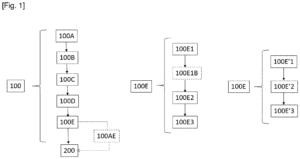
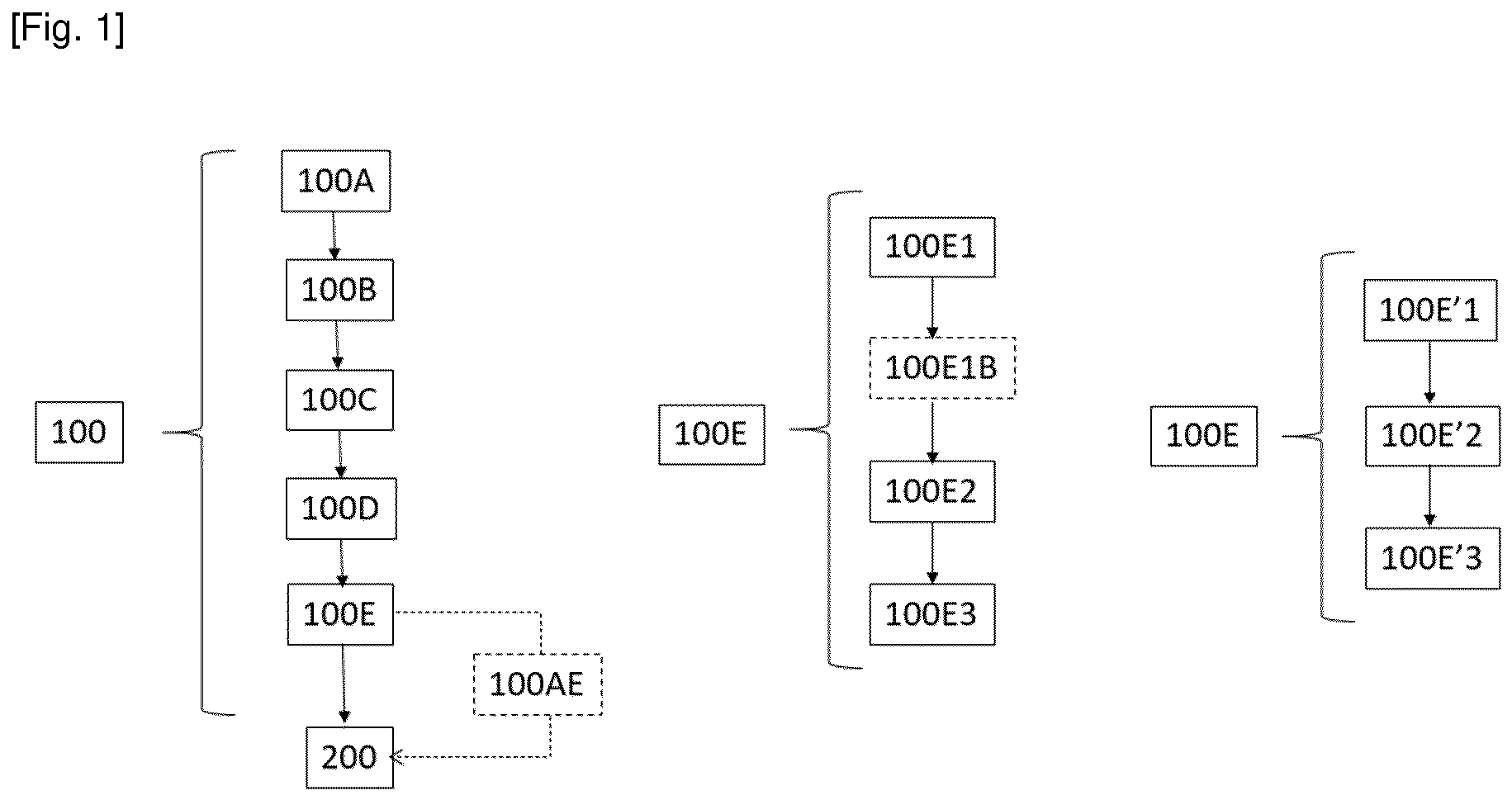
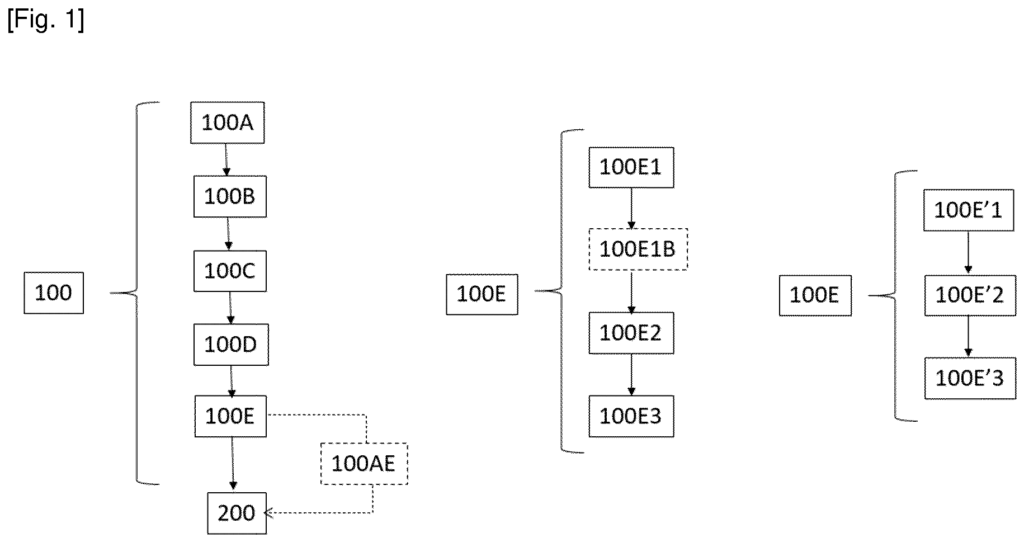
L’invention concerne un procédé de fabrication d’une pièce bi ou tri-dimensionnelle présentant une architecture composite avec au moins deux micro-treillis différents connectés l’un à l’autre, comprenant les étapes suivantes : effectuer (100) une étape de conception mise en œuvre par ordinateur comportant les étapes suivantes : A) définir (100A) un domaine représentant ladite pièce à fabriquer, puis définir un premier sous-domaine pour un premier micro-treillis et un deuxième sous-domaine, complémentaire au premier sous-domaine, pour délimiter un deuxième micro-treillis différent du premier micro-treillis ; B) définir (100B), sur l’ensemble du domaine, les coordonnées de centres générateurs pour le deux micro-treillis, C) définir (100C) le premier micro-treillis, D) définir (100D) le deuxième micro-treillis, E) connecter (100E) le deuxième micro-treillis au premier micro-treillis. L’étape de conception prévoyant aussi de définir une forme et des dimensions transversales associées pour chaque micro-poutre, puis : fabriquer (200) l’architecture ainsi conçue.
Contact : Daniel BONAMY (SPEC/SPHYNX).
Method for producing an amorphous architecture of the micro-lattice type formed of micro-beams connected together by nodes
The invention relates to a method for producing an amorphous three-dimensional architecture of the micro-lattice type formed of micro-beams connected together by nodes, which comprises: A) performing (100) a computer-implemented design step consisting, on the basis of a three-dimensional random arrangement (INIT) of non-deformable beads, in: a) producing (101) a three-dimensional random compact stack of said beads; b) for each bead, determining (102) the coordinates of the centre of the bead which correspond to those of a node; c) performing (103) a triangulation with said nodes, each triangle thus being defined with the nodes closest to one another, then associating two nodes connected by one side of a triangle to a micro-beam in order to define the micro-lattice; d) selecting (104) a sub-domain of the micro-lattice obtained in step c), not comprising the nodes located at the edge of the micro-lattice in order to define said amorphous three-dimensional architecture, the design step involving an average connectivity of the nodes greater than or equal to twelve, the design step providing for defining a shape and associated transverse dimensions for each micro-beam; and B) producing (200) the architecture designed in step A).
Contact: Daniel BONAMY (SPEC/SPHYNX).