



Lightweight neural network detects alpha particles from raw scintillation photons trains in real time using one PMT, with 0.5 % false positive rate and ultra-low computational cost.
- Project Title : Programmable Stream Processord
- CEA partner(s) : LETS, LNE-LNHB
- External partners : LEAD Dijon – Univ. Bourgogne
- Financements : ANR
- Status : Proof-of-Concept Finalised, Published
- Keywords : Alpha, Beta, Pulse Shape Discrimination, Neural Network,
Alpha/beta discrimination in liquid scintillation is essential for environmental monitoring and low-activity nuclear measurements. Traditional pulse-shape discrimination (PSD) relies on analog filtering and pulse tail integration. These approaches require complex electronics, are sensitive to noise and thresholds, and are difficult to embed in portable low-power devices. This work introduces a fundamentally different method: direct analysis of fast scintillation pulse trains using a lightweight artificial neural network (ANN).
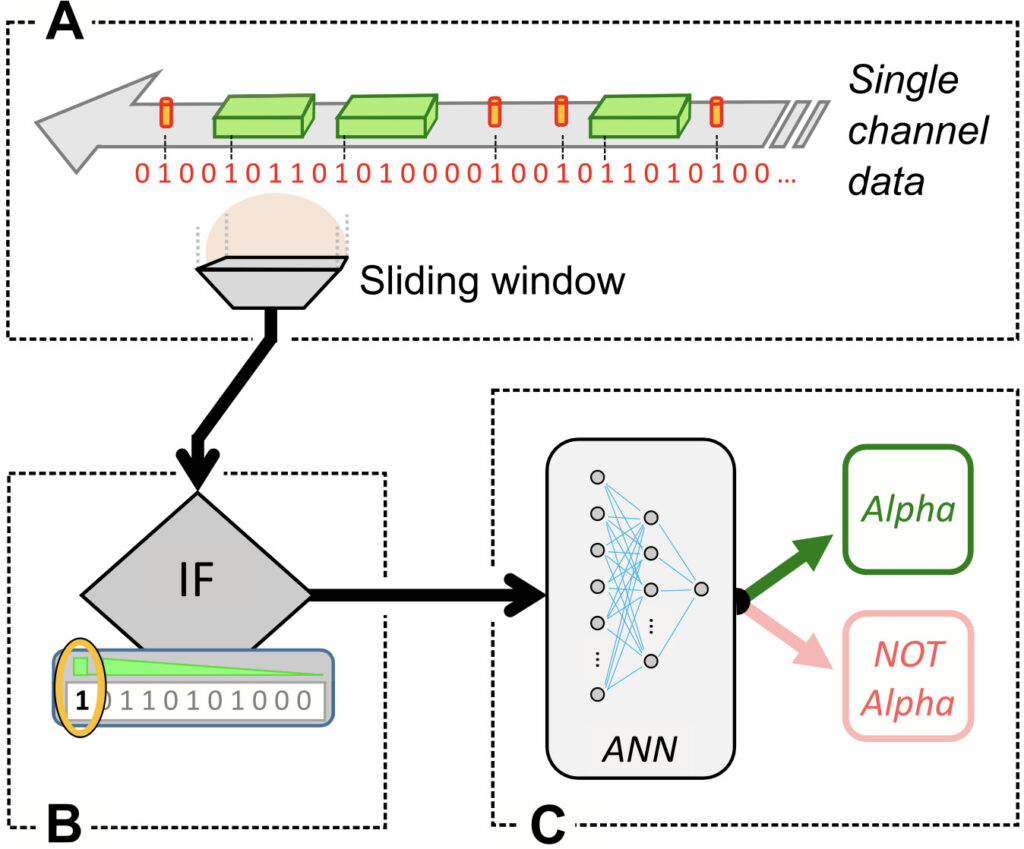
Instead of integrating pulses, the system classifies temporal signatures of delayed fluorescence, practically photons trains, enabling real-time operation with a single photomultiplier tube (PMT).
Method
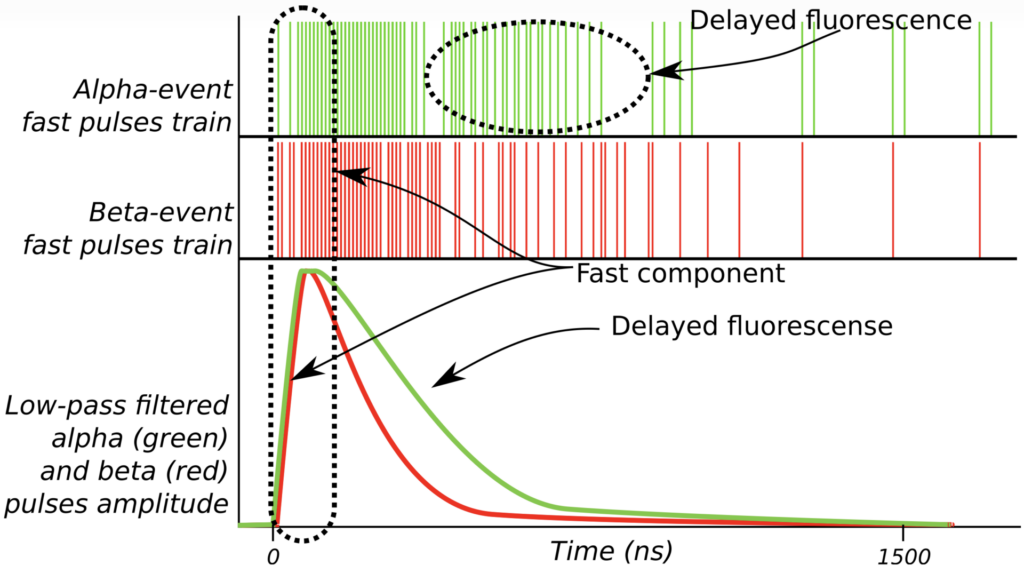
Alpha particles produce a higher delayed fluorescence component than beta particles. Rather than shaping or integrating pulses, the proposed method processes the raw fast pulse trains digitally and uses a trained ANN to detect the temporal signature of alpha interactions (trains of photons). This reframes alpha/beta discrimination as a time-series classification problem (see figure).
Experimental strategy
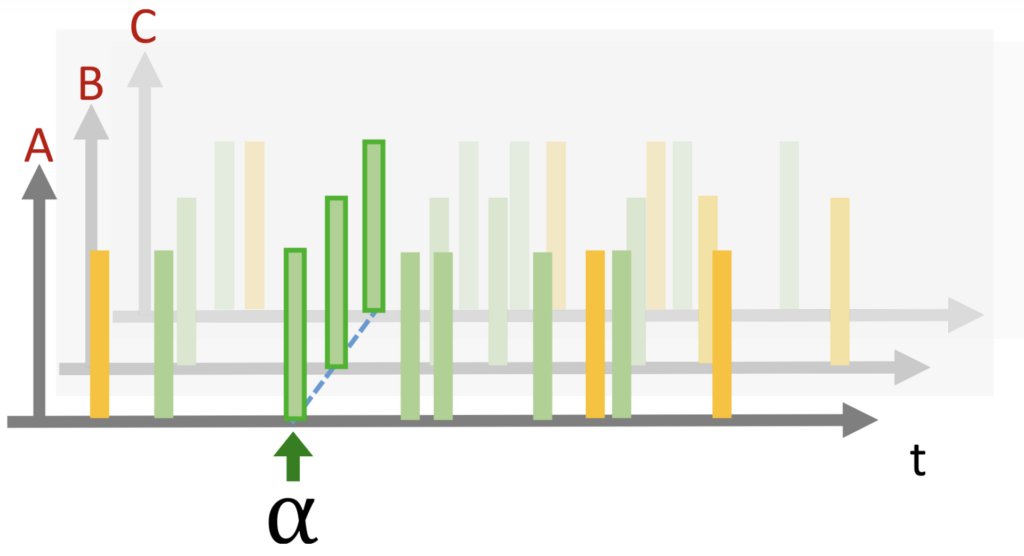
A Triple-to-Double Coincidence Ratio (TDCR) system with three PMTs was used to acquire experimental data, with a 0.995 % efficiency, it ensures a reliable labelling . Indeed, Alpha interactions from 241Am produce triple coincidences with very high probability, allowing reliable labeling of alpha events. The ANN is trained on labeled data but operates on a single PMT channel during deployment, reducing hardware complexity and cost. We connect the first dynode of the PMT to obtain the photon pulses.
Train of Photons as Signal Instead of Pulse
Each alpha event consists of a fast scintillation peak, a dead time, and a dense tail of delayed pulses lasting approximately 1500 ns. An Alpha Event Vector (AEV) of 2000 ns is extracted following the main peak. The delayed tail, not the pulse amplitude, is the discriminating feature learned by the ANN.
Neural network approach
A lightweight multilayer perceptron (MLP) with 25 inputs, 10 hidden neurons, and one output neuron was selected. The model contains only 271 trainable parameters and avoids computationally heavy convolutional networks. Data conditioning includes downsampling, use of the positive derivative of the signal, and removal of the initial peak during training to force learning of the delayed tail.
Performance
On real experimental data, the system achieves a correct detection rate of 91.0 %, a false-negative rate of 8.5%, and a false-positive rate of 0.5 %. The low false-positive rate is critical for continuous monitoring systems and enables robust alpha counting with a single detector channel.
Embedded feasibility
The ANN requires approximately 260 multiplications per event, corresponding to about 0.5 million operations per second in worst-case conditions. This makes the method compatible with low-power microcontrollers such as ARM Cortex-M4 and embedded neural accelerators. The system can be deployed in portable contamination monitors and autonomous field detectors.
Why this work matters
This work introduces the first method that directly analyzes fast scintillation pulse trains for alpha/beta discrimination. It demonstrates that edge artificial intelligence can replace analog PSD electronics while reducing cost, power consumption, and system complexity. The framework can be extended to neutron/gamma discrimination and other scintillation-based detection problems.