



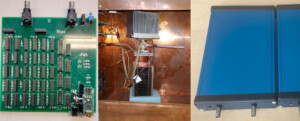
- Project title: RBOX, task attached to the MAGENTA project
- CEA collaborators: SPEC SPHYNX
- Project status: first prototype in 2022, 4 units in service in 2024
- Keywords: resistance, automated decade box, REED relays, Arduino, standalone
The objectives of this project are to better understand new thermoelectric phenomena in ionic liquids and ferrofluids, and then to transform this knowledge into concrete applications in the automotive industry and portable electronics. It also aims to structure an entire innovation ecosystem around this technology in order to optimize waste-heat recovery and its conversion into electricity.
The objectives of this project are to better understand new thermoelectric phenomena in ionic liquids and ferrofluids, and then to transform this knowledge into concrete applications in the automotive industry and portable electronics. It also aims to structure an entire innovation ecosystem around this technology in order to optimize waste-heat recovery and its conversion into electricity.
With the MAGENTA project (MAGnetic nanoparticle-based liquid ENergy materials for Thermoelectric device Application, Horizon 2020), we are exploring an alternative thermoelectric (TE) technology using ionic liquids and ferrofluids (colloidal dispersions of magnetic nanoparticles (MNPs) in ionic liquids) made from non-toxic materials that are abundant on Earth.
The Sphynx laboratory had to characterize the electrical power of a thermo-ionic cell. To do this, it built a measurement and characterization bench that includes various measuring instruments (nanovoltmeter, temperature sensors) and control devices (temperature control, ohmic load). To test different operating points, it is common to use a resistive decade box, but this requires manually changing the value between each operating point. To facilitate the work, we developed an automated decade box: it must generate a resistance between 1 ohm and 15 MΩ in 1-ohm steps (maximum power 1/4 W) and be controllable by a computer in Python or another language via a USB port.
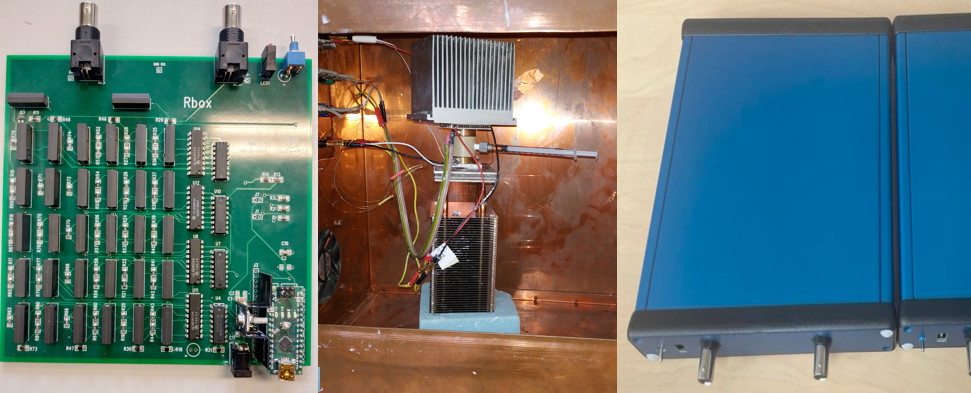
On the left, the RBOX board; in the center, the experimental setup including the thermoelectric system; on the right, the RBOX system in its enclosure.