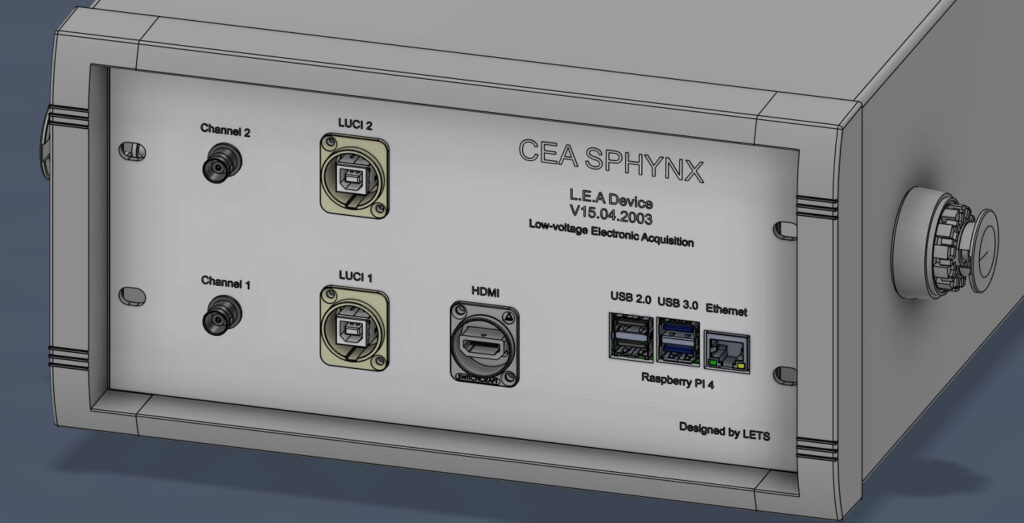



- Project name : L.E.A Device (Low-voltage Electronic Acquisition) version 15.04.2003 Système d’acquisition Bi-voie (Nanovoltmètre numérique), tâche attachée au projet WH-RECOLTE
- Partnets CEA: SPEC/SPHYNX
- Status: working prototype in lab environment
- Keywords: nanovoltmeter, multichannel acquisition, Raspberry Pi, Python, adaptive sampling, thermoelectrochemistry, electromagnetic shielding
As part of the WH-RECOLTE project funded by the French National Research Agency (ANR), the SPHYNX laboratory is studying the conversion of waste heat into electricity using new liquid thermoelectric cells. The aim of this project is to develop devices capable of recovering residual heat, thereby providing a decarbonized and environmentally friendly alternative to traditional solid-state semiconductors.
However, the SPHYNX laboratory faced a major hardware limitation in characterizing these devices: measuring the extremely weak signals generated by the cells had, until now, required the use of standard laboratory nanovoltmeters. Although highly accurate, such equipment is extremely expensive and bulky, making it poorly suited to large-scale deployment or mobile measurement campaigns.
To address this issue and facilitate the work of researchers, the Laboratory of Electronics and Signal Processing (LETS) designed an alternative measurement instrument that is compact, cost-effective, and fully digitally controlled. The architecture of this new acquisition chain is based on Femto precision amplifiers, an MCC 128 board, and a Raspberry Pi 4 single-board computer.
The software architecture, initially started by interns Aya Teguia and Eaklim Hour, was fully corrected and optimized in Python by intern Lina Nouira to incorporate asynchronous acquisition (parallelism) and an intelligent adaptive sampling algorithm, under the supervision of engineer Frédéric Coneggo.
The hardware design was then carried out by Lina Nouira, under the technical supervision of engineer Amine Afroun. The final device is housed in a custom 3D-modeled metal enclosure, ensuring line separation and strict electromagnetic shielding in order to guarantee the metrological accuracy of the measurements.