


Project Title: Laser Control System for LIBS Spectroscopy
CEA Collaborators: LEDNA
External Collaborators: RIM60
Funding: PEPR
Start Date: 2025
Project Status: Pre-commissioning tests
Keywords: LIBS, laser, spectroscopy, control, electronics
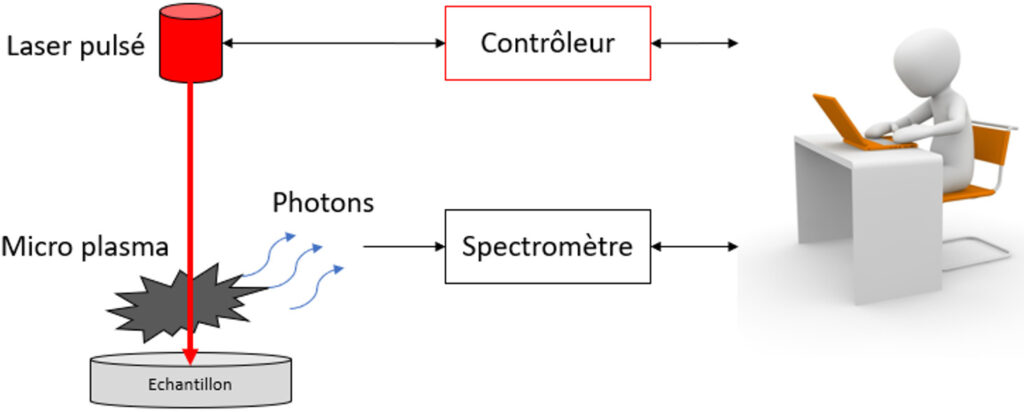
Laser-Induced Breakdown Spectroscopy (LIBS) is an analytical technique used for qualitative and quantitative elemental analysis of materials. It is a form of optical emission spectroscopy based on the generation of a low-temperature plasma using a focused laser pulse. The basic principle of LIBS consists in focusing a high-power pulsed laser beam onto the surface of a sample. When the irradiance exceeds a certain threshold (typically 10 GW/cm²), the laser energy is absorbed, leading to rapid overheating, vaporization, and partial ionization of the sample. This results in the formation of a microplasma composed of excited atoms, ions, and electrons. As the microplasma cools, atoms and ions de-excite, emitting photons whose energy, expressed in eV, is directly related to changes in the energy levels of the atoms and ions. The emitted light contains spectral lines characteristic of the atomic elements present in the sample.
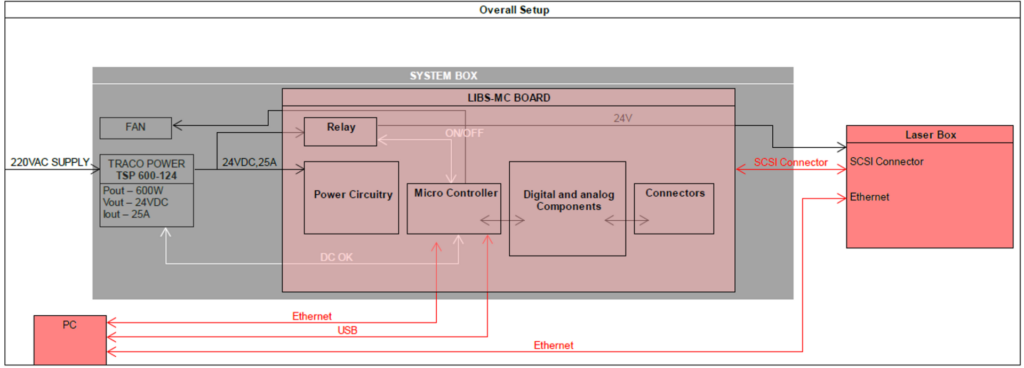
LIBS spectroscopy is used at LEDNA with an industrial SPI G4 laser. Since the laser interface is incomplete and incompatible with the tools used in the laboratory, we propose a new control system composed of: an electronic board based on a microcontroller developed at LETS, a power supply 24 V / 600 W power supply providing the power required by the laser and the control board; and a fan to remove the heat dissipated by the system. The system can be remotely controlled via USB and Ethernet using a Python library.
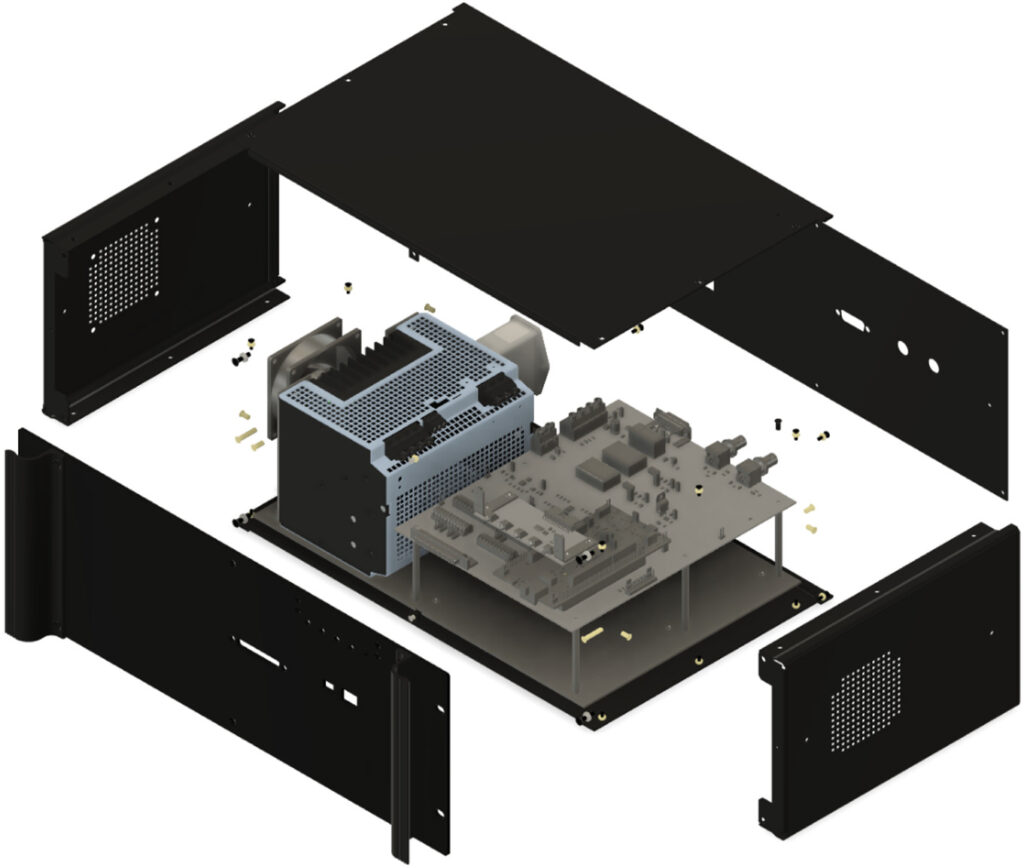
Integration of the system into a 19-inch rack-mountable 4U enclosure (436 × 178 × 265 mm) is in progress. The front panel includes USB and Ethernet connectors for communication with the user’s PC, a 68-pin SCSI connector for laser control, LED indicators, and a push button to restart the system. The rear panel includes the mains filter input for powering the system, a high-power SUB-D connector for laser power supply, and two BNC connectors for the system’s input and output triggers.