



- Project title: DIAgnostic with Magnetic Sensors for Sepsis (DIAMSS), Spindiag
- CEA collaborators: LNO, LERI
- External collaborators: hôpital Antoine Béclère, DesignSpot, Bold Design
- Project status: integration of the first prototype in progress
- Keywords: biochip, GMR, magnetism, instrumentation, electronics
Sepsis, an uncontrolled immune response to an infection that then spreads into the bloodstream, leads to organ dysfunction and can result in the patient’s death. The WHO estimates that 49 million people are affected by sepsis each year worldwide, causing 11 million deaths. It particularly affects children and the elderly and is especially devastating in underdeveloped countries. Sepsis is therefore a major public health issue and a national priority in research and healthcare. The earlier sepsis is identified and managed, the greater the patient’s chances of survival. Early diagnosis is therefore crucial.
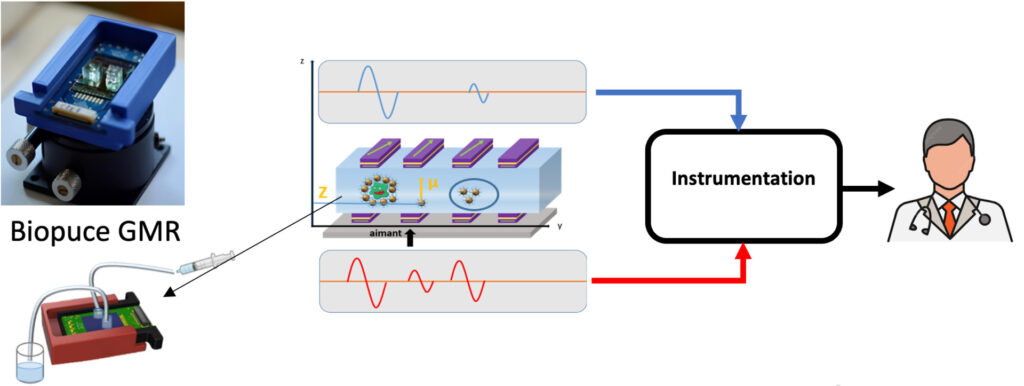
The patented biochip based on GMR (Giant MagnetoResistance) sensors developed by LNO shows real potential for early sepsis detection. It is sensitive, easy to use, low-cost, usable with biological targets of different sizes in complex—even opaque—matrices, and enables rapid diagnosis (2.5 hours). This innovative approach is cross-disciplinary because it is based on the use of magnetic nanoparticles. These are functionalized with monoclonal antibodies produced at the CEA’s LERI laboratory, then directed against the target biological objects (cells, bacteria, etc.), which are detected individually, dynamically, and simultaneously by GMR sensors arranged on either side of a microfluidic channel through which they flow.
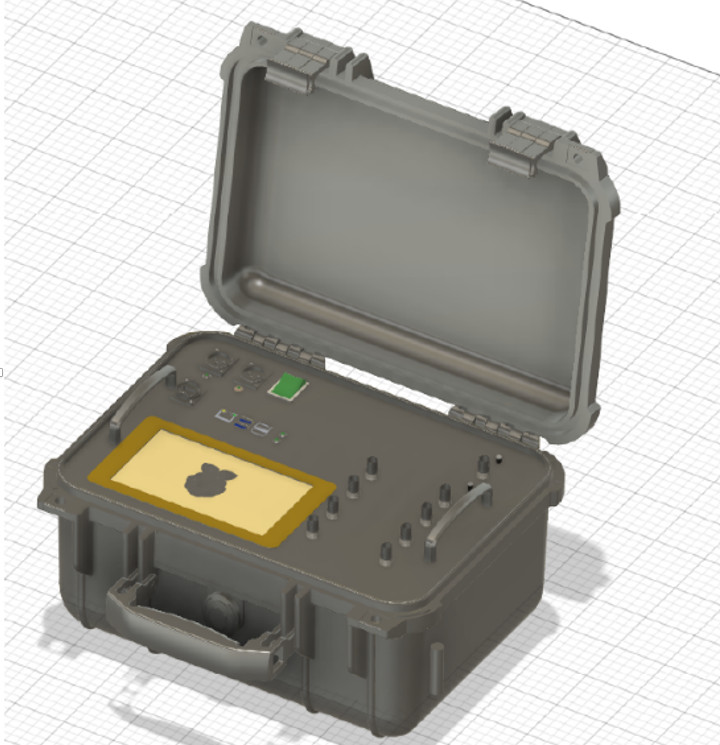
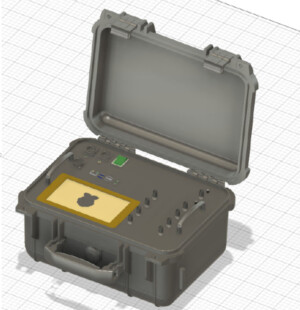
The instrumentation of the GMR biochip enables signal processing from the GMR sensors for detecting biological targets in the microfluidic channel. Thanks to the project’s various funding sources, several modules were developed at LETS by students: an AC current source to power Helmholtz coils for calibrating the GMR sensors; a low-noise amplifier to amplify the raw signal from the GMR sensors; and a fast multi-channel synchronous acquisition board (1 Msps). As part of the PocInLab funding, the design center of Université Paris-Saclay proposed an integration solution based on a portable case. Integration is currently in progress.