


Project Title: Diapason
CEA Collaborators: SPEC LNO and LEPO
Project Status: Prototypes delivered and in use
Keywords: tuning fork, 32 kHz frequency, micrometer-scale positioning measurement
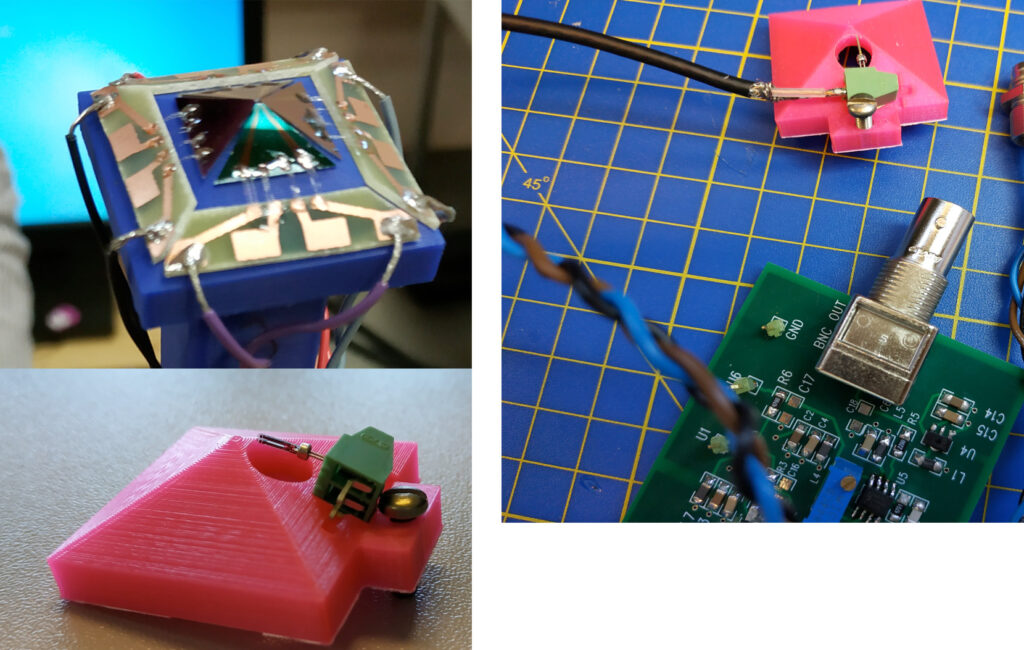
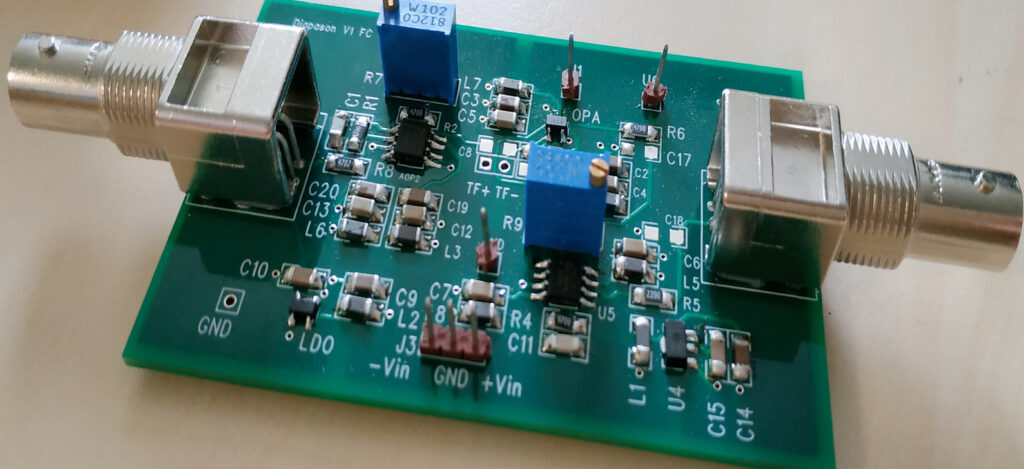
In order to measure and detect the near magnetic field using their GMR sensor fabricated in-house in the nanofab, the LNO laboratory needed a very precise distance/proximity measurement system (on the order of micrometers) to position their GMR sensor extremely accurately for measuring a surface magnetic field. I based the design on the electronic principle schematic provided by L.V.P., from which I extracted a schematic, and then carried out the placement and routing on the printed circuit board.
The quartz tuning fork serves as a very stable time reference in electronics and watchmaking, and it is also used as an approach-control system in atomic force microscopes.
The tuning fork is excited by a low-frequency generator at its resonance frequency of about 32,750 Hz, causing it to vibrate. When it gets close enough to a surface, interaction forces modify the vibration amplitude, and this variation is measured via the voltage across its terminals by a detection system that extracts the signal at the tuning fork frequency before sending it to an acquisition board.
Its measurement range was validated at LNO between 0 and 4 µm from the surface; beyond that, Van der Waals and electrostatic interaction forces no longer act on the tuning fork.