


- Project Title: Data Acquisition System for an Ion Mobility Spectrometer
- CEA Collaborators: NIMBE LIONS
- External Collaborators: MaSaTECH
- Start Date: 2022
- Project Status: First prototype delivered
- Keywords: IMS, spectroscopy, laser, instrumentation, electronics
Ion Mobility Spectrometry (IMS) is a form of mass spectrometry that enables elemental analysis of a material in the gas phase. First, the sample molecules are ionized, for example using a corona discharge. The ions thus formed are then injected into a tube, called a “drift tube,” which is subjected to an electric field and a gas flow. The ions move at a velocity that depends in particular on their mass and structure. The larger and heavier the ions, the more significant their collisions with the carrier gas. This slows down their velocity in the tube; this is referred to as mobility-based separation. The ions are finally detected upon arrival at the end of the drift tube using an electron detector. The ion drift time is therefore directly related to their chemical nature (mass and structure). Mobility is defined by the formula K = L/(E.td) where L is the length of the drift tube in meters, td is the drift time in seconds, and E is the electric field strength applied to the drift tube in volts.
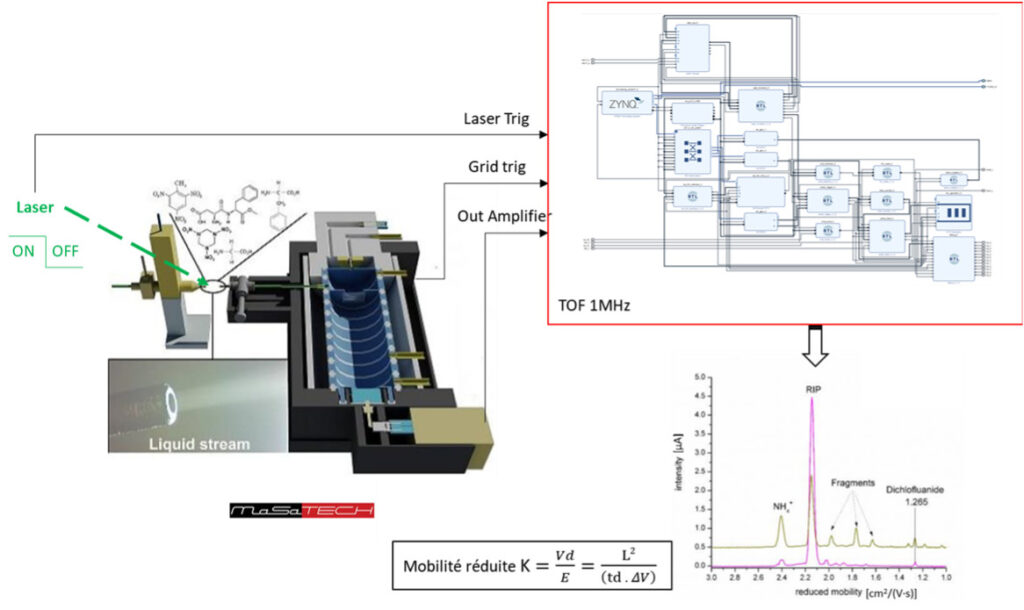
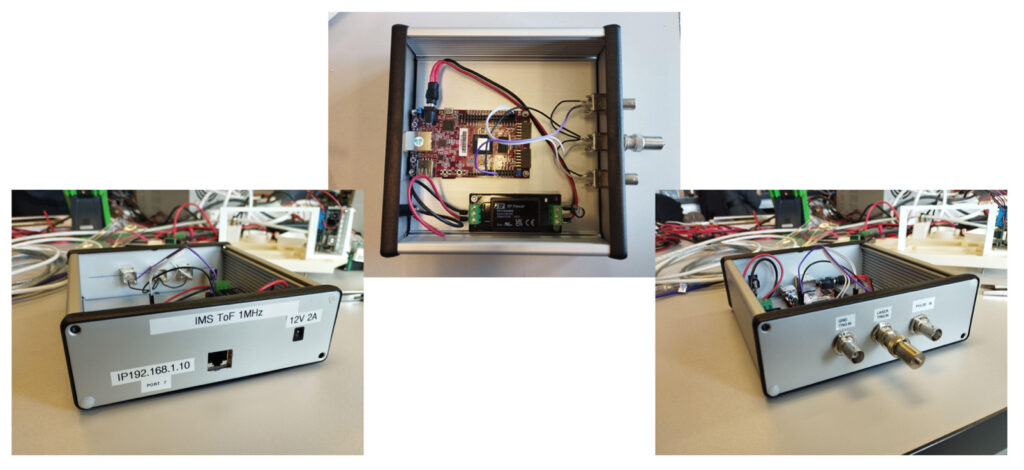
The objective of this project is to instrument an experiment developed at NIMBE, based on a MaSaTECH IMS spectrometer coupled with a pulsed laser, for the detection of chemical agents on surfaces. To this end, we developed an FPGA-based system to synchronize the IMS spectrometer with the laser and to determine the ion drift time. This makes it possible to compute the mobility of each ion and thereby infer its chemical nature. The system is based on an FPGA and a 1 MS/s analog-to-digital converter. It computes the drift time t_d from the IMS signals (trigger from the ion injection grid into the drift tube, detector output signal) and from the laser output trigger. The system can be controlled over Ethernet using a Python library.