


Peptides and proteins bind to the surface of plastic nanoparticles to form a crown. Researchers at CEA-Joliot and CEA-Iramis (NIMBE/LIONS) have demonstrated, using molecular modeling, distinct adsorption behaviors depending on amino acid sequences. They have thus established a mechanistic basis for predicting peptide-plastic interactions, an essential element for assessing the risks these interactions pose to human health and ecosystems.
For more information: Fabrique de savoirs – Comprendre les interactions microplastiques-protéines pour lutter contre la pollution
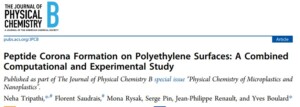
N. Tripathi, F. Saudrais, M. Rysak, S. Pin, J-P. Renault and Y. Boulard. Peptide corona formation on polyethylene surfaces: a combined computational and experimental study. | J. Phys. Chem B 2025, 129, 13289-13305 ;https://doi.org/10.1021/acs.jpcb.5c06013