



Researchers from LSDRM Lab at NIMBE have combined multinuclear NMR and simulations to decode lithium-ion transport in deep eutectic solvent electrolytes, paving the way for safer, higher-voltage batteries.
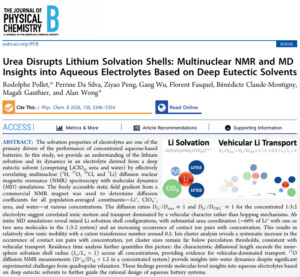
Aqueous electrolytes based on deep eutectic solvents offer a promising route to safer, higher-voltage batteries, but understanding how lithium ions move through these crowded, water-poor environments has remained a challenge. In our recent study, published in The Journal of Physical Chemistry B [1], we combined multinuclear NMR diffusion measurements with molecular dynamics simulations to map out lithium solvation and transport in a LiClO₄–urea–water electrolyte.
The study takes advantage of the static fringe field that surrounds any commercial NMR magnet, a field gradient that is freely available but normally left unused. The high magnitude field gradient (beyond using the specific gradient system) made it possible to measure the diffusion of every species in the electrolyte at once, including lithium, water, urea, and the perchlorate anion, and to reach nuclei that are usually set aside because of their weak signal and fast relaxation: oxygen-17 and chlorine-35.
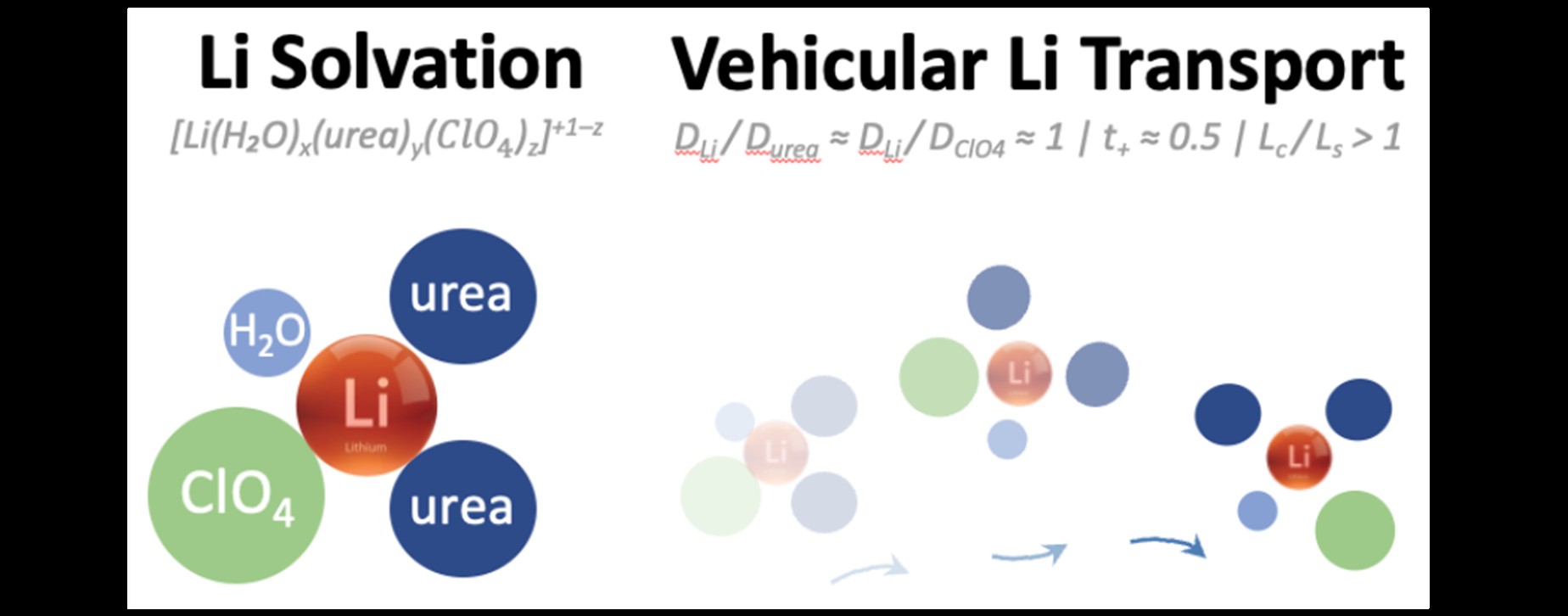
Combining these measurements with ab initio molecular dynamics shows that urea substantially reshapes the lithium coordination shell, replacing water and forming mixed configurations. At the highest concentration studied, about two-thirds of lithium ions associate with one or more urea molecules. Despite this reorganization, lithium, perchlorate, and urea are found to diffuse at comparable rates, and the cation transference number reaches around 0.5. Together with a comparison of diffusion length to solvation shell size, these observations point to a vehicular transport mechanism, in which lithium ions migrate as a group with their surrounding solvation shell rather than hopping between coordination sites.
These results illustrate how multinuclear NMR, including nuclei that are usually set aside as poor sources of information, can be paired with simulation to give a molecular-level picture of ion transport in concentrated aqueous electrolytes, information that can help guide the design of future battery electrolytes.
[1] R. Pollet, P. Da Silva, Z. Peng, G. Wu, F. Fasquel, B. Claude-Montigny, M. Gauthier, A. Wong, “Urea Disrupts Lithium Solvation Shells: Multinuclear NMR and MD Insights into Aqueous Electrolytes Based on Deep Eutectic Solvents,” J. Phys. Chem. B 2026, 130, 5346–5354. https://doi.org/10.1021/acs.jpcb.5c08411
Contact : Alan Wong