

How can we predict the distribution of waves propagating through an inhomogeneous medium or one crossed by a background flow? Researchers at SPHYNX at SPEC (UMR CEA–CNRS) have developed a new approach based on equilibrium statistical mechanics. By combining conservation of wave action, conservation of absolute frequency and an ergodic hypothesis, they establish a framework for directly predicting the spatial statistics of a wave field, without having to track a large number of individual trajectories. Numerically validated for several surface-wave systems, this approach provides a general principle for describing the statistical organization of waves in inhomogeneous or moving media.
From ocean surface waves to internal waves in the atmosphere, wave propagation can be strongly modified by the medium through which the waves travel. A current can deflect them, while variations in depth or other inhomogeneities can locally alter their propagation. When the wavelength is much shorter than the scale over which the medium varies, these phenomena are generally described using ray tracing, an approach analogous to geometrical optics that follows the trajectories of wave packets. However, when the aim is no longer to track a particular wave but to predict the statistical properties of an ensemble of waves, a large number of trajectories must be simulated. This rapidly becomes computationally intensive and does not reveal an overarching principle governing the large-scale organization of the wave field.
To overcome this limitation, the researchers adapt a classical tool from statistical physics to waves: the microcanonical ensemble, in a generalized form suited to a linear wave system. In a steady medium whose properties vary slowly on the scale of the wavelength, each wave packet conserves its wave action as well as its absolute frequency, namely the frequency measured by a stationary observer in a fixed reference frame. Its evolution can then be described in phase space, combining position and wave vector. When this dynamics leads to sufficiently chaotic motion, the ergodic hypothesis amounts to assuming that, over long times, wave action becomes uniformly distributed among the states accessible at a given frequency. This prescription makes it possible to calculate the local wave spectrum and derive various statistical quantities from it.
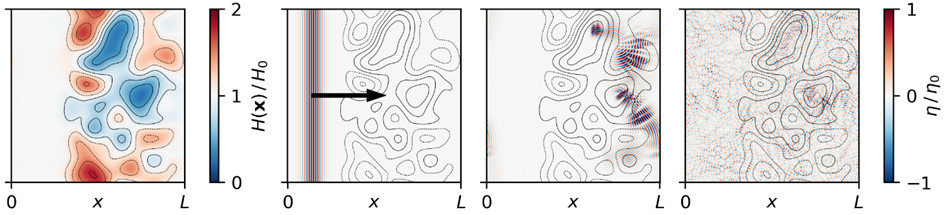
Left: Map of the local bathymetry, represented by the water depth H(x) with mean value H₀.
Right: Three maps of surface elevation η(x), normalised by its initial maximum value η₀. The wave packet, initially located on the left-hand side of the domain, propagates to the right, is deflected by the topography at short-time, and then spreads across the entire domain until it reaches a statistically stationary state.
The researchers first apply this approach to shallow-water gravity waves. Two situations are considered: spatially varying depth with no background flow, and uniform depth in the presence of a spatially inhomogeneous flow. Using their statistical model, they predict the spatial distributions of surface elevation fluctuations and interfacial slope. These predictions are then compared with numerical simulations in which an initial wave packet propagates, is scattered by the background inhomogeneities and eventually reaches a statistically steady state. The theoretical maps closely reproduce those obtained from the simulations, both for topographic inhomogeneities and for a background flow.
To test the scope of the framework beyond this first case, the researchers then apply it to deep-water capillary waves, whose dispersion relation differs from that of gravity waves. They consider short waves propagating over a large-scale background flow and, using the same microcanonical principle, derive the expected spatial distributions of surface elevation fluctuations and interfacial slope. Once again, the numerical simulations closely reproduce the structures predicted by the theory. The agreement obtained for these different systems shows that the approach can be applied to waves with distinct propagation properties.
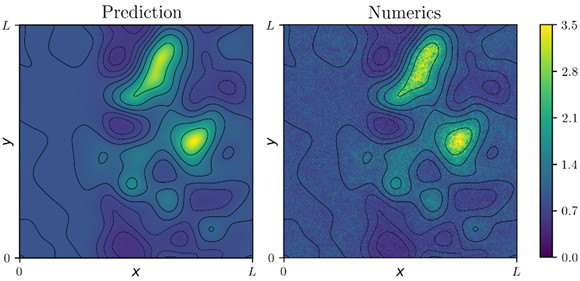
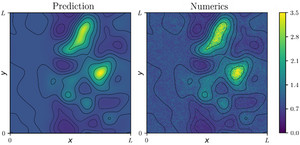
A gauche : prédiction théorique. A droite : résultat numérique. Dans les deux cas, la carte de couleur représente ≺η²≻(x) (en unité arbitraire) et les contours noirs représentent les lignes de niveau bathymétriques. La prédiction est en très bon accord avec l’observation numérique, sans aucun paramètre d’ajustement.
Beyond the accuracy of the predictions obtained for the systems considered here, this work provides a common conceptual framework for describing the statistics of short waves propagating through steady inhomogeneous or moving media. Compared with existing statistical approaches for inhomogeneous media, one key advantage is that it can predict wave-field statistics for a given realization of the medium, without requiring an average over multiple realizations. This could be particularly relevant in geophysical settings, for instance for waves propagating through ocean currents whose evolution occurs on much longer timescales than that of the waves themselves. More broadly, by establishing a bridge between wave physics and equilibrium statistical mechanics, this work opens up a new way of addressing the statistical organization of complex wave systems. The present framework remains limited to linear waves: incorporating wave-wave interactions and feedback of the wave field onto the background flow is a natural next step towards extending the approach to more complex and realistic situations.
Reference
Equilibrium Statistical Mechanics of Waves in Inhomogeneous Moving Media.
Alexandre Tlili, Basile Gallet. Phys. Rev. Lett. 136, 244001 (2026).
Contact
- Basile Gallet and Alexandre Tlili, researchers at SPHYNX, SPEC.