



In condensed matter physics, a spin wave is a magnetic disturbance that propagates within a material. These collective excitations, also known as “magnons,” are oscillation modes of the spin lattice. It has recently been shown that these spin waves can be detected by coupling them to a magnetoresistive sensor operating at very high frequencies.
Spin waves, or “magnons,” are modes of local magnetic vibration in a material. It is now proposed to use this type of wave to transport information in new processing architectures, called “magnonic,” and to couple them to magnetic devices able to record this information. The transfer requires the use of microelectronic circuits, which involves converting spin waves into an electrical signal. However, with the techniques used to date, such as optical imaging or inductive detection, it is difficult to detect these waves at scales smaller than a micrometer, whereas current technologies are developing at the nanometric scale and require the development of new methods.
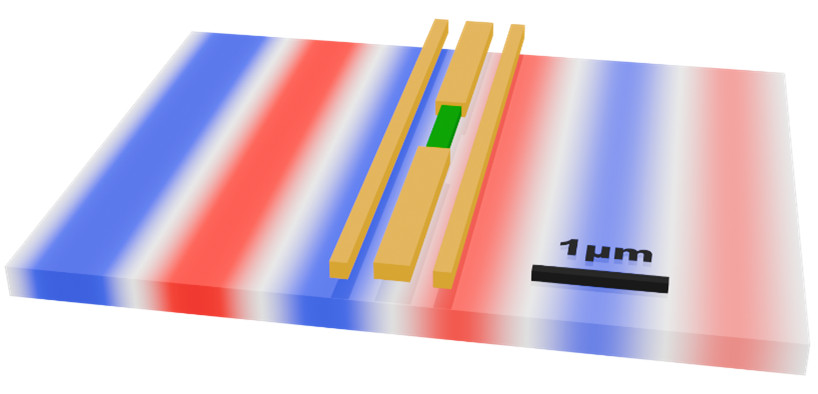
As part of the national PEPR Spin program, a new method has been developed to detect spin waves more efficiently. To do this, a giant magnetoresistance (GMR) sensor is directly integrated under a waveguide. The passage of waves near the sensor causes the magnetization of the soft layer of the sensor to oscillate slightly, which modifies its resistance. This oscillation at several gigahertz of the resistance leads to a measurable electrical signal. Thanks to this device, and for an equivalent detection surface, a signal fifty times more intense than that obtained with the inductive method can be detected. This measurement shows that magnetoresistive detection works remarkably well at the nanometric scale and for these very high frequencies. These results are confirmed by numerical simulations that accurately reproduce the behavior of the signal measured in the laboratory.
Figure: Representation of the magnetoresistive sensor (in green) and its connection electrodes (gold). The blue-red color represents the oscillation (+/-) of magnetization by a spin wave. Credit: Quentin Rossi.
This innovation paves the way for ultra-compact spin wave sensors able to operate in extreme conditions (at scales smaller than 100 nm, or using spin waves generated by thermal fluctuations, for example). It could also make it easier to integrate magnonics into conventional electronic circuits, enabling the design of new architectures that are faster and more energy efficient. Furthermore, by using more sensitive sensors, such as tunnel magnetoresistance (TMR) sensors, it should be possible to further increase the signal.
These results are published in the Science Advances journal.
CEA – IRAMIS contact: Grégoire de Loubens, Aurélie Solignac, Hugo Merbouche (SPEC/LNO).
Collaboration:
- Institut de Physique et Chimie des Matériaux de Strasbourg – IPCMS, UMR CNRS -Université de Strasbourg,
- Service de Physique de l’État Condensé (SPEC, UMR CEA-CNRS)
Reference:
Magnetoresistive detection of spin waves, Quentin Rossi, Daniel Stoeffler, Gregoire De Loubens, Hugo Merbouche, Hicham Majjad, Yves Henry, Igor Ngouagnia, Aurelie Solignac, Matthieu Bailleul, Science Advances 11 (2025) eadx4126 – hal.science/hal-05215204.
See also:
- Actualité du CNRS-Physique : “Détection magnétorésistive des ondes de spin“.
- On the IPCMS website