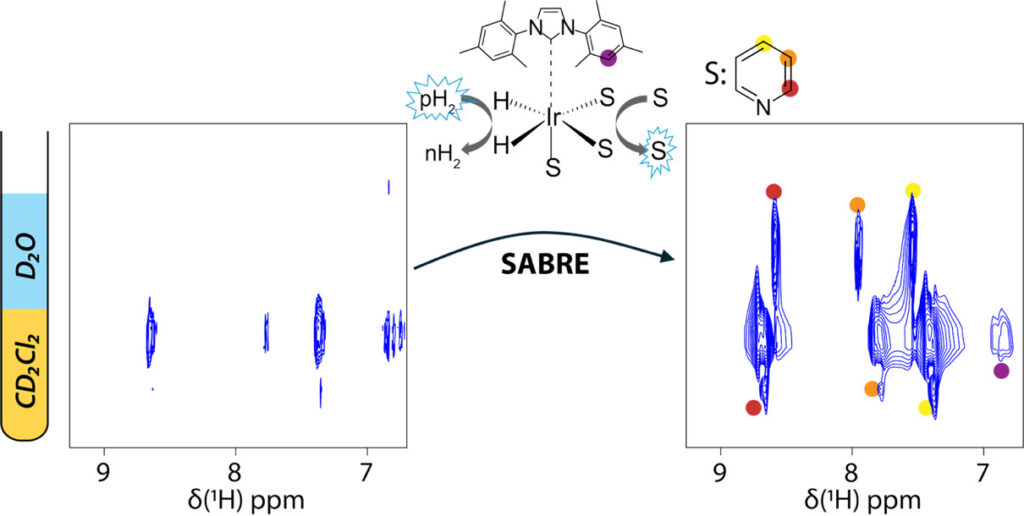




There are many situations in which localized yet detailed chemical information needs to be obtained quickly, and NMR can be a valuable tool for this purpose. The study of hyperpolarised species in solution is one such example. Indeed, it is necessary to rapidly identify the molecular entities formed in the early stages of dissolution or mixing, and in all cases before the magnetization returns to thermal equilibrium.
A new localized spectroscopy approach known as CSI (Chemical Shift Imaging) has been developed for this purpose and successfully tested on species hyperpolarized by the SABRE method using para-hydrogen. In this method, hyperpolarisation is produced in the organic phase, but for biological applications, the species must be transferred as quickly as possible to an aqueous phase. In order to provide molecular information in both phases simultaneously and rapidly, several techniques have been combined: i) the selection of a ‘rotating’ longitudinal slice in the xy plane to minimise the number of spins excited several times in succession (Figure 1a–b, showing this selection and the associated gradient profile), ii) an optimal centric phase encoding to handle the transient nature of hyperpolarisation, and iii) the use of a gradient echo avoiding inversion pulses (Figure 1c)
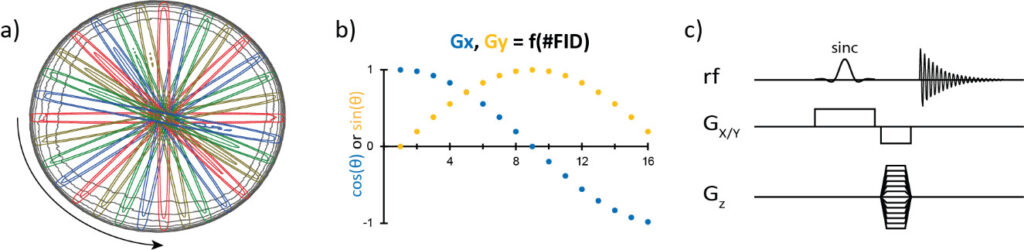
Figure 2 shows the result for a dichloromethane/water two-phase solution, with an initial concentration of 5 mM catalyst and 25 mM pyridine in the organic phase. On the right, following hyperpolarisation, a gain of approximately two orders of magnitude in signal intensity is achieved, and the transferred pyridine is observed in the aqueous phase. Each of these maps was acquired in 8 seconds; they are displayed with the same intensity levels.