




Microfluidics
The microfluidics is the science associated to the technology of systems that process or manipulate small amounts of fluids (nanoliter to attoliter), using channels with dimensions of tens to hundreds of micrometers. For more than a decade, microfluidics has become a powerful tool used in fundamental and applied research: microfluidics can play a key role in fields such as chemical synthesis, biological analysis, optics, and information technology.

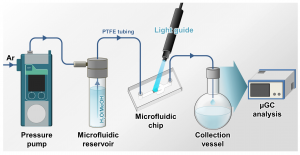
Microfluidic instrumentation
Since recent years, microfluidics are used in the experimental research of the NIMBE/LIONS.. The flexibility of this tool allows to address:
- fundamental problems of chemistry such as the nucleation / growth of nanoparticles or the extraction of salts in liquid-liquid phase
- physics problems with interfaces, among other things, the development of a model system of Pickering emulsion
- and also more applied research on the development of microfluidic chips for medical research/diagnosis.
All these topics are involved in national and internal research programs. One of the key objectives is to adapt these tools for in-situ measurements on large instruments. A partnership is underway with the SOLEIL synchrotron to develop a common synergy around microfluidics. The NIMBE/LIONS team is contributing its expertise in microfluidics to develop new chip manufacturing processes that are compatible with synchrotron radiation and ionizing radiation..