


Rare earth elements (REEs) are essential to the production of the modern integrated electronic devices that are ubiquitous in our daily lives, and are therefore of strategic importance to our economy and security. Our electronic waste already contains all these elements, but their low overall concentration makes it difficult to recover them profitably without a major recycling effort, which represents a major challenge.
In a publication appearing in ACS Sustainable Resource Management, Jean-Christophe Gabriel’s team from NIMBE/LICSEN, the SCARCE laboratory in Singapore and CEA-ICSM propose modifying the extraction process to achieve economically viable recovery while reducing the environmental impact of the hydrometallurgical processes currently in use.
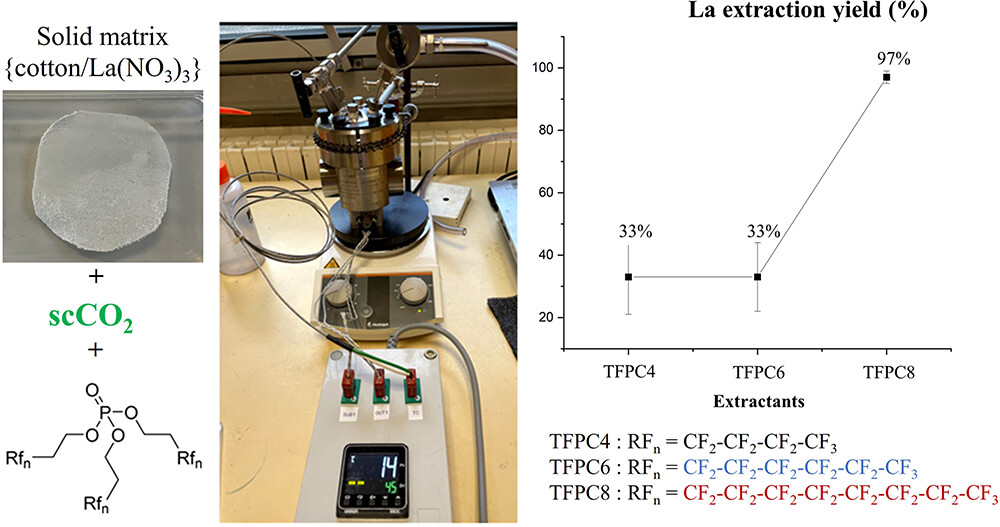
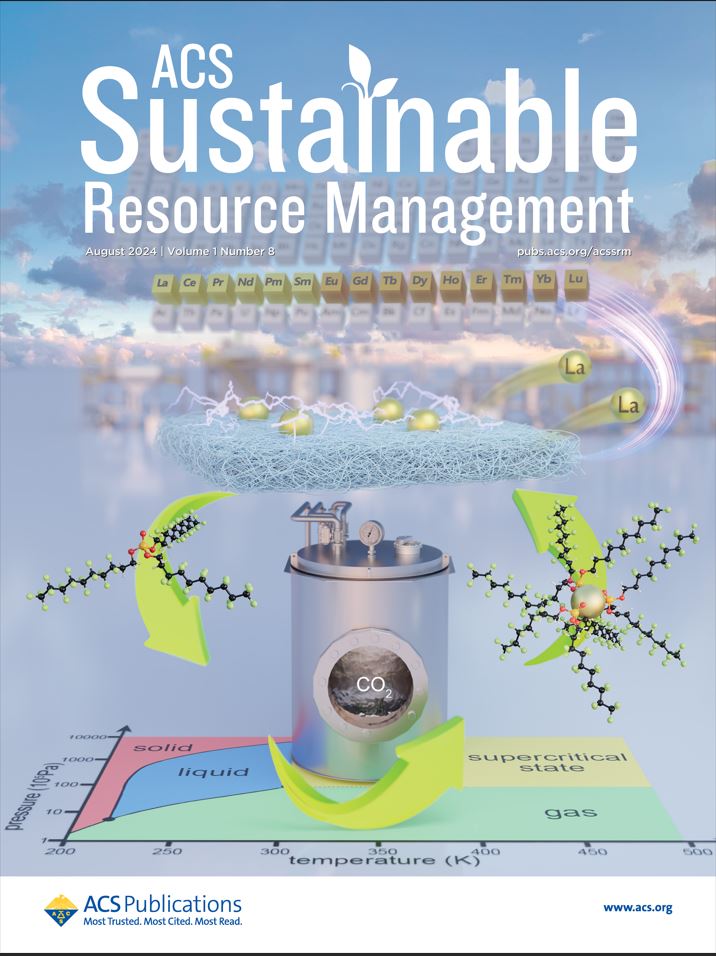
Figure 1 :
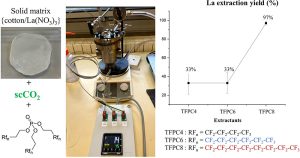
- Rare earth deposits on cotton pads and extraction by supercritical CO2 (SC-CO2) and fluorinated organophosphorus extractants (TFP) synthesised from fluorinated alcohols and phosphorus(V) oxychloride Rf = n-C4F9,
- Experimental set-up
- Efficiency of lanthanum extraction using three different TFP extractants in a solid SC-CO2 extraction at T = 333.15 K and P = 200 bar.
The major result obtained is the production of new extraction molecules with exceptional solubility and extraction efficiency in supercritical carbon dioxide. This process opens up a possible alternative to traditional hydrometallurgical processes, which could meet the urgent need for sustainable methods of recovering and separating rare earths.
Reference :
Yuemin Deng, Dong Xia, Damien Bourgeois, Daniel Meyer, Stéphane Campidelli, Hélène Isnard, Victor Francois, Robin Ronceray, Bertrand Reygner, and Jean-Christophe P. Gabriel*
ACS Sustainable Resource Management 2024, 1, 8, 1780.
Collaboration :
- Jean-Christophe P. Gabriel − Université Paris-Saclay, CEA, CNRS, NIMBE, LICSEN, 91191 Gif-sur-Yvette, France ; SCARCE Laboratory, Energy Research Institute, Nanyang
Technological University, 639798 Singapore, Singapore;
orcid.org/0000-0002-0194-683X; Email: - Yuemin Deng − Université Paris-Saclay, CEA, CNRS,
NIMBE, LICSEN, 91191 Gif-sur-Yvette, France;
Ecologic France, 78280 Guyancourt, France - Dong Xia − SCARCE Laboratory, Energy Research Institute,
Nanyang Technological University, 639798 Singapore,
Singapore - Damien Bourgeois et Daniel Meyer − Université de Montpellier, ICSM, CEA,
CNRS, ENSCM, 30207 Bagnols-sur-Cèze, France - Stéphane Campidelli − Université Paris-Saclay, CEA, CNRS,
NIMBE, LICSEN, 91191 Gif-sur-Yvette, France; orcid.org/0000-0001-6060-4891 - Hélène Isnard − Université Paris-Saclay, CEA, DEN, DPC,
SEARS, LANIE, 91191 Gif-sur-Yvette, France; orcid.org/0000-0002-5802-369X - Victor Francois, Robin Ronceray et Bertrand Reygner − Ecologic France, 78280 Guyancourt, France