



We present an experimental study of convection-evaporation of a pool of water evaporating into a quiescent atmosphere.
Remise-Charlot H; Bombled M; Alba-Simionesco C; Davaille A
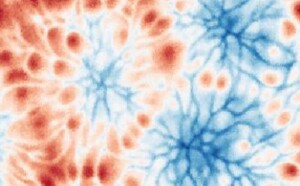
The temperature difference between the bottom of the pool and the surrounding air, as well as the water layer’s aspect ratio Γ , are systematically varied. Compared with classical Rayleigh-B & eacute;nard convection (RBC), this configuration involves a free-surface mechanical upper boundary and a mixed thermal upper boundary in contact with a poorly conducting air layer: evaporation extracts latent heat from the liquid and injects lighter vapour into the air, while radiation adds further cooling. As a result, neither temperature nor heat flux is fixed at the water-air interface, but they are instead strongly coupled. To characterise the respective contributions of convection, evaporation and radiation, we perform three sets of experiments: convection-evaporation, evaporation without bottom heating and convection without evaporation. High-resolution infrared imaging reveals multiple scales of convection at the surface: small hot plumes, cold sheet-like plumes and a large-scale circulation. The latter is constrained by the tank geometry for Γ< 12 , but several turbulent superstructures develop for larger Γ . This is reminiscent of RBC but with different temperature statistics, due to the mixed boundary condition. Scaling laws are derived for interfacial transfers and mean surface temperature. Evaporation dominates heat extraction, accounting for 60 %-70 % of the flux, while radiation contributes 15 %-20 %. The release of vapour further enhances coupling between the liquid and air layers. When evaporation is blocked, radiation becomes dominant (70 %-80 %).These results have important implications for industrial and natural systems.