



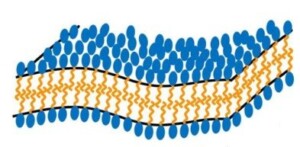
Self-assembled bioconjugates into nanoparticles (NPs) represent a powerful strategy to enhance drug efficacy.
Hugo Roncin, Sinda Lepetre-Mouelhi, Gaspard Huber, Javier Perez, Anne Martel, Lorenzo Metilli, Emeline Cournede, Frederic Gobeaux, Fabienne Testard
In the case of Leu-enkephalin-squalene (LENK-SQ) bioconjugate, self-assembly leads to spherical NPs internally organized into a sponge phase, which exhibit significant analgesic activity, in contrast to the free Leuenkephalin (LENK) peptide, whose therapeutic use is severely limited by its rapid degradation and poor bioavailability. However, the presence of an ionizable group in the LENK peptide part raises questions regarding the structural evolution of these nano-assemblies under physiologically relevant conditions across a range of pH values and ionic strengths. Here, using a combination of small- and wide-angle X-ray scattering (SAXS and WAXS), small angle neutron scattering (SANS) and cryogenic transmission electron microscopy (cryo-TEM), we demonstrate that LENK-SQ sponge-phase NPs formed in water undergo an unexpected structural transition toward elongated micelles when exposed to buffered environments with defined pH and ionic strength. Under blood-mimicking conditions (pH ~ 7.4, ionic strength ~170 mM), the NPs reorganize into wormlike micelles. At low ionic strength, the transition becomes noticeable from pH ~ 6.6, above the apparent pKa of the LENK moiety of the LENK-SQ that forms the bilayer of the sponge phase, suggesting that micellization is primarily driven by peptide ionization. Furthermore, increasing the ionic strength promotes micelle elongation, consistent with electrostatic screening effects. These findings demonstrate that LENK-SQ behaves as a peptide amphiphile (PA) with high versatility in self-assembled morphologies depending on environmental conditions. Beyond addressing how sponge-phase NPs may evolve structurally after intravenous administration, this study opens avenues for investigating the potential influence of self-assembled morphologies on pharmaceutical activity.