



Pectin-based hydrogels have attracted considerable interest due to their wide range of applications in the agri-food, pharmaceutical, and biomedical fields (encapsulation and targeted release of active substances, proteins, probiotics, vitamins, etc.). These hydrogels exhibit remarkable properties, such as tunable mechanical behavior, high water content, biodegradability, and biocompatibility, which can be adjusted by modifying the gelation protocol.
In this study, researchers investigated the influence of partial methylation of polygalacturonate (polyGalA) chains, the main constituent of pectins, on the structure of calcium-ion-crosslinked hydrogels. Hydrogels prepared from partially methylated polyGalA were found to be more porous and mechanically weaker, but exhibited reduced macroscopic heterogeneity compared with those prepared from non-methylated polyGalA. These differences can be attributed to changes in the helical conformation of partially methylated polyGalA chains and to their reduced ability to associate in the presence of calcium ions, as suggested by complementary numerical simulations.
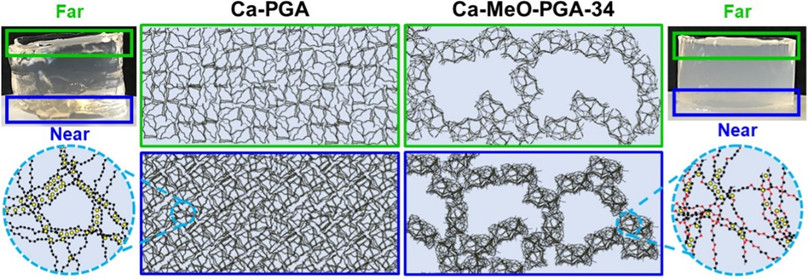
Pectin-based hydrogels formed by external ionotropic gelation are widely used in pharmaceutical and agri-food applications for the encapsulation of active substances (AS). Their performance strongly depends on their internal structure in terms of pore size, homogeneity, and, consequently, mechanical rigidity. This study examines how partial methylation of polygalacturonate (polyGalA) chains affects the structure of calcium-crosslinked gels, with the aim of understanding how this chemical modification enables modulation of gel porosity, stiffness, and diffusion of active substances within the hydrogel network.
Hydrogels prepared from non-methylated polyGalA (degree of methylation, DM = 0%) are transparent, homogeneous, and mechanically stiff. One end of these hydrogels exhibits a pore size of approximately 7 nm, while the opposite end is looser. This structural heterogeneity arises from a polyGalA concentration gradient induced by calcium ion diffusion and polymer chain reorganization during the gelation process. As the degree of methylation increases, the gels become more turbid and less rigid; the pore size at the first end increases (up to 14 nm for DM = 34%), and mesoscopic heterogeneities emerge. The study also shows that the chemical reaction used to methylate polyGalA leads to a decrease in molar mass and chain viscosity, along with an increase in chain stiffness, as reflected by a larger persistence length.
Molecular simulations reveal that methylation promotes a helical chain conformation that is less favorable for the formation of stable calcium-mediated junctions. Moreover, calcium ions bind to carboxylate groups via a bidentate coordination mode, differing from that proposed in the classical “egg-box” model. In addition, the presence of methyl groups reduces the length of junction zones, which likely accounts for the increased fragility of partially methylated gels.
Overall, partial methylation of polyGalA appears to be a promising strategy for tailoring hydrogel structure to specific requirements, including controlled diffusion, optimized mechanical rigidity, and targeted encapsulation. Future studies could investigate the effect of methyl group distribution (random versus blockwise) and the influence of methylation on longer polymer chains.
Reference
Mikaela Börjesson, Giovanni Tizzanini, Anna Ström, Adrien Lerbret, Fabrice Cousin, Ali Assifaoui, Impact of methyl-esterification on the microstructure of calcium-induced polygalacturonic acid gels, Carbohydrate Polymers, 2025.
Collaboration
- Laboratoire Léon Brillouin (CEA-Saclay).
- Université Bourgogne Europe, L’Institut Agro, INRAE, UMR PAM (Dijon, France).
- Department of Chemistry and Chemical Engineering, Université de technologie Chalmers (Göteborg, Suède).
Contact CEA-IRAMIS
Fabrice Cousin – Laboratoire Léon Brillouin (LLB), CEA-IRAMIS.