


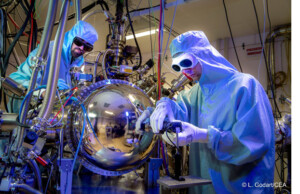
Scientists from LIDYL (CEA Saclay), from the DICO and ATTO groups have completed the commissioning of PANORAMIX, a new experimental platform dedicated to spin- and time-resolved angle-resolved photoemission spectroscopy (STARPES). This instrument enables the investigation of the ultrafast dynamics of electrons and their spin degree of freedom in quantum materials, with temporal resolutions on the femtosecond to picosecond scale.
Angle-resolved photoemission spectroscopy (ARPES) is now one of the benchmark techniques for probing the electronic structure of materials. By measuring the energy and momentum of electrons emitted under ultraviolet irradiation, it provides direct access to the electronic band structure. Adding time resolution through a pump–probe approach makes it possible to follow the ultrafast evolution of these electronic states after optical excitation. When the spin polarization of the electrons is also measured, charge and spin dynamics can be observed simultaneously, opening the way to the study of fundamental phenomena in topological materials, valley semiconductors, and correlated systems of interest for spintronic applications.
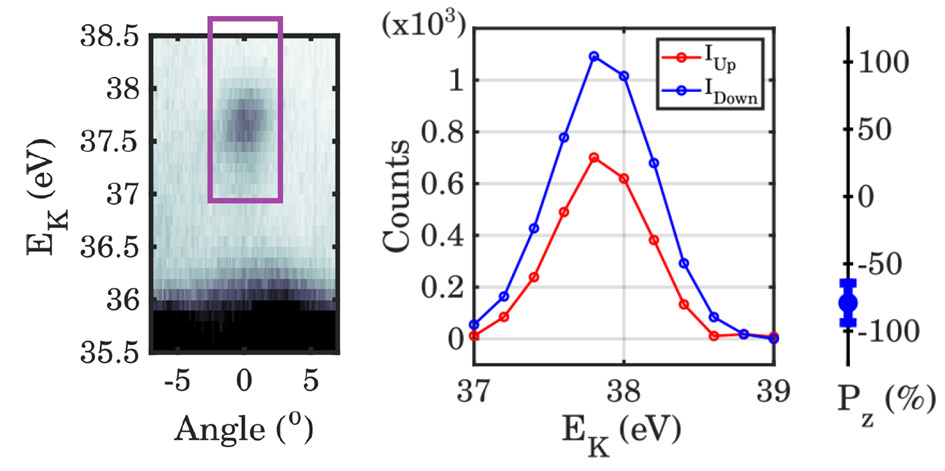
(left) Angle-resolved photoemission spectrum showing the conduction band of a WSe₂ crystal populated by optical pumping resonant with the band-gap energy. (right) Spin-resolved intensity curve of the conduction band. Adapted from M. Fanciulli et al., PRL 131, 066402 (2023).
Combining all these experimental dimensions remains particularly challenging. Spin detectors are intrinsically inefficient, requiring high photoelectron fluxes. This constraint becomes even more severe when the probe radiation is produced through high-harmonic generation (HHG), an essential source for reaching the photon energies needed to explore the entire Brillouin zone of many materials.
Between 2018 and 2023, the FAB10 beamline was developed at LIDYL as a versatile platform designed to accommodate a variety of users and experimental configurations [1]. Among the experiments carried out on this facility were the first STARPES measurements using HHG, performed in collaboration with the Laboratoire de Physique des Matériaux et des Surfaces at CY Cergy Paris University. These studies enabled the observation of spin polarization and its associated dynamics in excitons of resonantly excited tungsten diselenide (WSe₂), highlighting the richness of valley-spin phenomena in quasi-two-dimensional materials [2].
Between 2023 and 2025, the LIDYL teams undertook a complete upgrade of the facility to permanently integrate an experimental station dedicated to STARPES. This evolution was accompanied by a redesign of the beamline, now renamed PANORAMIX.
The PANORAMIX platform currently operates with a temporal resolution of approximately 350 fs, with prospects for future developments toward pulse durations close to 30 fs. Its laser delivers pulses at a variable repetition rate ranging from 1 to 200 kHz. The pump arm provides excitations at 1.2 eV or 2.4 eV, with either linear or circular polarization and fluences adapted to the study of nonequilibrium dynamics in a wide range of materials. The probe arm is based on an XUV source produced by high-harmonic generation, linearly polarized and subsequently monochromatized. The optimal photon energy, around 26 eV, enables access to the edge of the Brillouin zone in the majority of materials studied in condensed-matter physics.
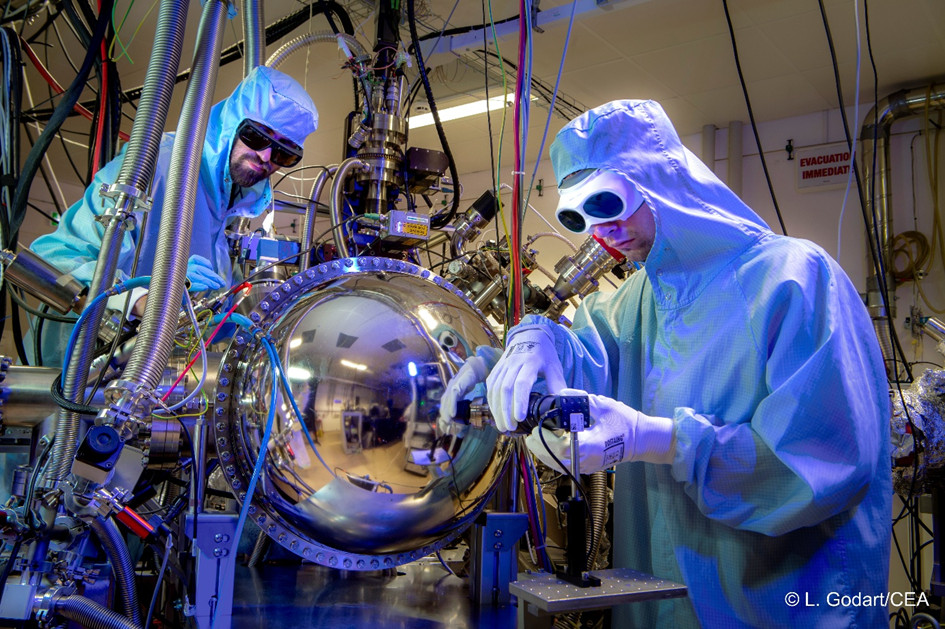
Compared with the historical FAB10 configuration, which operated at 10 kHz with an 800 nm fundamental laser, PANORAMIX benefits from a substantial increase in repetition rate as well as a significant improvement in harmonic-generation efficiency through the use of a 515 nm driving wavelength. These advances greatly reduce acquisition times, a crucial issue for STARPES experiments, which are limited both by the low counting efficiency of spin detectors and by space-charge effects associated with pulsed sources. The platform also incorporates an active beam-stabilization system, ensuring greater robustness of measurements over extended acquisition periods.
The first experiment on PANORAMIX was carried out in October 2025. The first external users were welcomed in May 2026. The instrument is now open to the French scientific community through the LUMA infrastructure, as well as to international users via the Laser4EU program.
In addition to its primary operating mode dedicated to STARPES, PANORAMIX offers a second mode that allows direct use of the full spectrum of generated harmonics. This configuration opens the way to the future development of attosecond spectroscopy experiments and new approaches for investigating ultrafast electronic and spintronic dynamics.
References
1. FAB10: a user-oriented bandwidth-tunable extreme ultraviolet lightsource for investigations of femtosecond to attosecond dynamics in gas and condensed phases
D. Bresteau, C. Spezzani, O. Tcherbakoff, J.-F. Hergott, F. Lepetit, P. D’Oliveira, P. Salières, R. Géneaux, M. Luttmann, I. Vadillo-Torre, J. Lenfant, S. J. Weber, M. Dehlinger, E. Meltchakov, F. Delmotte, C. Bourassin-Bouchet, J. Im, Z. Chen, J. Caillaux, J. Zhang, M. Marsi, L. Barreau, L. Poisson, D. Dowek, M. Fanciulli , O. Heckmann, M. C. Richter, K. Hricovini, M. Sebdaoui, D. Dennetiere, F. Polack and T. Ruchon, Eur. Phys. J. Spec. Top. 232, (2023) 2011–2029 – HAL-Science.
2. Ultrafast hidden spin polarization dynamics of bright and dark excitons in 2H − WSe2
M. Fanciulli, J. Gaudin, D. Bresteau, S. Dong, R. Géneaux, T. Ruchon, O. Tcherbakoff, O. Heckmann, M. C. Richter, K. Hricovini and S. Beaulieu, Phys. Rev. Lett. 131, (2023) 066402 – HAL-Science.
Contacts
- Mauro FANCIULLI, CEA Saclay and Cergy Paris University
- David BRESTEAU, CEA Saclay