
Description
Water confined at the nanometric scale exhibits unexpected behavior, as demonstrated by recent advances in nanofluidics [1]. One striking example is the so-called dielectric anomaly: under strong confinement, the dielectric permittivity of water decreases by a factor of 40 compared with its bulk value [2]. This phenomenon has important implications for biological processes occurring at the nanoscale, as well as for energy-storage applications such as supercapacitors.
Yet, the physical mechanism responsible for the dielectric anomaly is still the subject of ongoing debate in the literature [3]. A major obstacle is the scarcity of experimental data on the subject. The aim of this project is to develop a dielectric spectroscopy platform capable of probing not only the static response but also the dynamics of polar liquids under extreme confinement. This will be achieved by fabricating nanochannels within stacks of 2D materials, such as graphite or hBN, which offer exceptionally flat surfaces and allow the channel thickness to be controlled with sub-nanometer precision [2] (see figure below). By combining the lab’s expertise on the spectroscopy of polar liquids with recent advances in nanofluidics, we aim to access experimental regimes that were previously out of reach and to elucidate the role of dipolar correlations in the dielectric response of liquids under confinement.
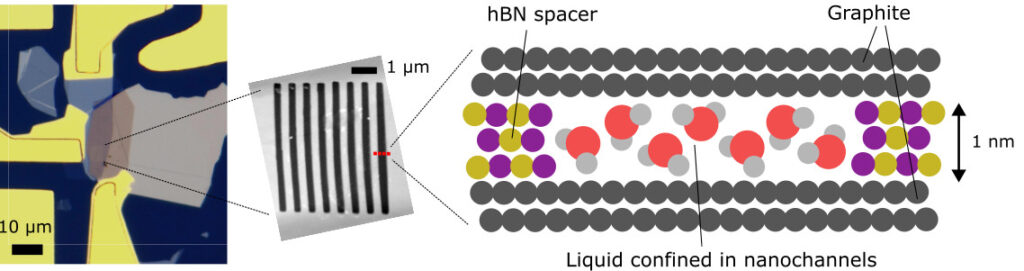
Left: Optical image of the device showing a stack of 2D materials. Center: AFM image of nanochannels. Right: Schematic of a cross-section of a nanochannel filled with water.
We are looking for a master’s student with a background in physics, materials science or physical chemistry, with a strong interest in exploring questions at the interface between the physics of liquids and interfacial phenomena. During the internship, the student will learn and gain experience in nanofabrication, development of experimental devices and dielectric spectroscopy. This internship may lead to a PhD (funded by ANR JCJC).
References:
[1] Bocquet, Nat. Mat. 2020.
[2] Fumagalli et al., Science, 2018.
[3] Olivieri et al., JCP, 2021.
Location
CEA Saclay, Site de l’Orme des merisiers (91) Essonne, France
Internship conditions
- Internship duration: 4 à 6 mois
- Level of study: Bac+5
- Training: Master 2
- Continuation in PhD thesis: Yes (funded)
- Application deadline: january 31st 2027
Experimental skills
The student should have a Master level background in liquid physics, condensed matter or material science. Prior experience with nanofabrication is a plus but not mandatory.
Language : English or French
Useful methods and technics to be acquired during the internship:
Dielectric spectroscopy, nanofabrication in clean room, development of experimental devices.
Computer languages and software:
Python
Supervisor
Marceau Hénot
Email :