

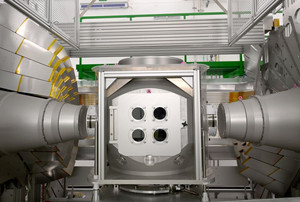
On 23 September 2026, DREAM, a neutron powder diffractometer, was officially inaugurated at the European Spallation Source – ESS in Lund, Sweden. Developed through a Franco-German collaboration between the Laboratoire Léon Brillouin – LLB (UMR CEA–CNRS) and the Jülich Centre for Neutron Science – JCNS at Forschungszentrum Jülich, the instrument has reached a major milestone ahead of the arrival of the first neutrons. Designed to investigate the atomic structures and magnetic properties of materials, DREAM will open up new research opportunities in nanoscience, energy materials and magnetism.
Following several years of design, construction and installation, DREAM has successfully passed its final safety review before receiving neutrons (Instrument Safety Readiness Review). This marks a major step in the development of the neutron powder diffractometer and paves the way for its commissioning. The teams are now preparing for the first scientific experiments, while ESS, a major European research facility currently being brought into operation, is expected to produce its first neutrons in early 2027.
DREAM will allow researchers to probe the internal structure of materials using neutron diffraction. By analysing how neutrons are scattered by a sample, this technique provides insights into how atoms are arranged within materials and reveals aspects of their magnetic properties. With its versatile capabilities, DREAM will open up new avenues of research in physics and chemistry, particularly in nanoscience, materials for energy storage and batteries, and complex magnetic structures. LLB will be involved in investigating the latter from the very first measurements.
One of DREAM‘s key strengths is its operational flexibility. Taking full advantage of the ESS neutron source, particularly its long neutron pulses and exceptional peak brilliance, the instrument can be optimised for either high resolution or high intensity, depending on the experimental requirements. In practice, researchers will be able to perform highly precise measurements to resolve fine structural details, or faster measurements to monitor how materials evolve, for example during battery operation. This flexibility will enable scientists to investigate a wide variety of materials and phenomena under conditions tailored to their research questions.
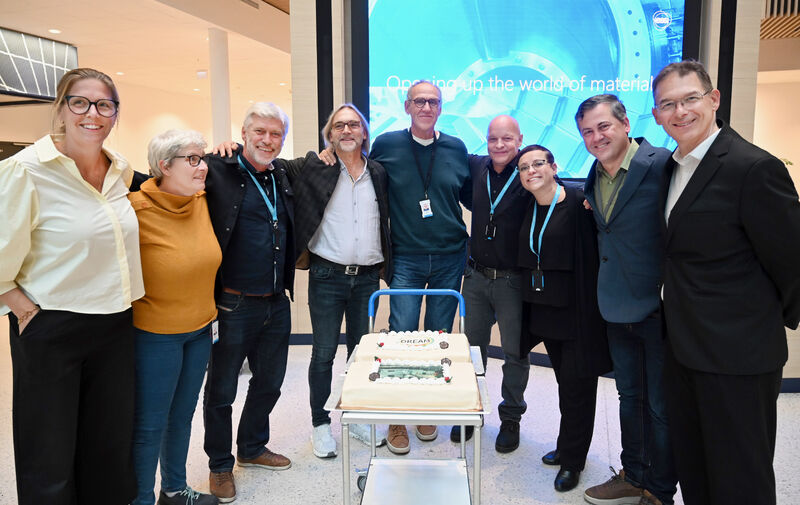
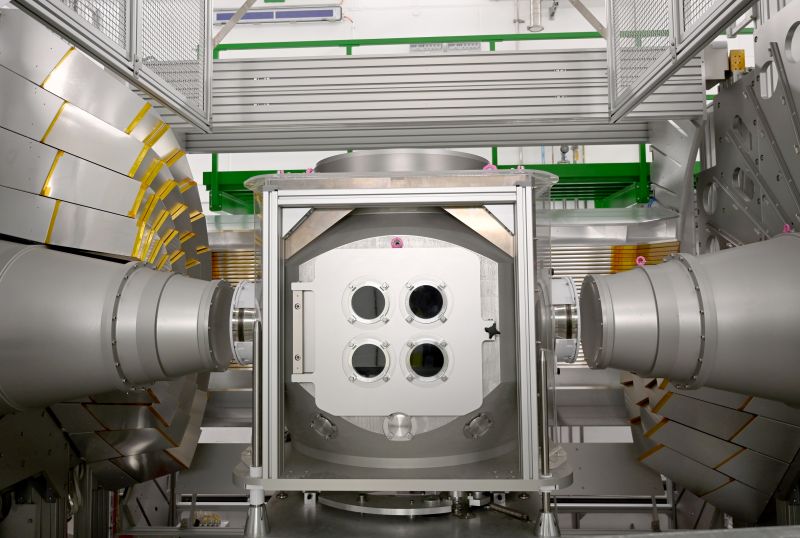
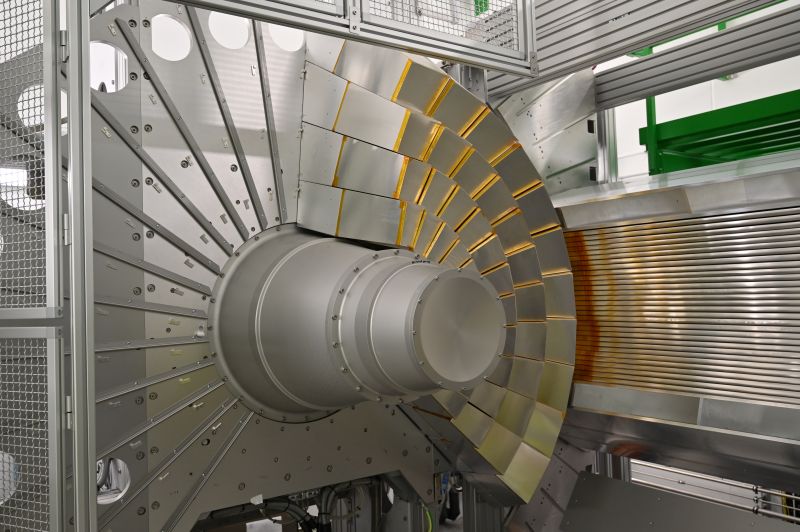
Photo caption : Inauguration of the DREAM diffractometer at ESS on 23 September 2026, attended by Giovanna Fragneto (ESS Science Director), Tania Claudio Weber and Andreas Wischnewski (JCNS), Arnaud Desmedt (LLB Director), and Florence Porcher (LLB researcher seconded to ESS as DREAM Lead Scientist). Sylvain Désert, an LLB engineer also seconded to ESS and involved in the development of DREAM, was unable to attend the ceremony.
Established in 2014, this Franco-German collaboration brings together the scientific and instrumental expertise of LLB and JCNS, working closely with ESS teams to provide the European research community with a powerful new diffraction instrument. The inauguration ceremony on 23 September, attended by the partners involved in DREAM’s construction, marked the culmination of more than a decade of joint efforts. For LLB, the work now continues with further testing, calibration and fine-tuning of the instrument ahead of its first experiments with neutrons. In the longer term, the laboratory will also be able to provide scientific and technical support to DREAM users as needed. Meanwhile, LLB teams are continuing their contribution to the development of MAGiC, another ESS diffractometer designed to investigate magnetism. Its delivery will represent another important milestone in LLB’s contribution to the ESS instrument programme, with project completion expected in 2027.
Contacts
- Florence Porcher & Arnaud Desmedt, researchers at LLB.