

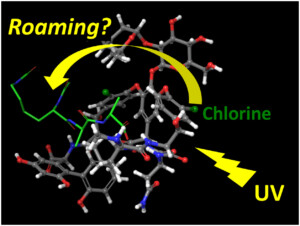
Researchers at CIMAP (Joint research unit UMR CEA-CNRS-ENSICAEN-Université de Caen Normandie), in collaboration with the SOLEIL synchrotron and INRAE, have shown that an unusual chemical mechanism previously observed only in small molecules could also occur in much larger systems. Their results, obtained using a complex involving vancomycin, an antibiotic containing more than 170 atoms, point to the involvement of this so-called “roaming atom” mechanism and open up new avenues for understanding chemical reactions in large molecules, particularly those relevant to biology and pharmacology.
During a chemical reaction, a molecular system generally follows a pathway that passes through a particular arrangement of atoms, known as a “transition state”, before forming the reaction products. Some reactions, however, can take more unexpected routes. One such process is known as “atom roaming”: instead of following the conventional pathway, an atom, or group of atoms, bypasses the transition state and moves through the molecular system before eventually reacting. First identified around two decades ago, this mechanism can account for reactions that are difficult to explain using conventional models.
Until now, however, roaming had only been observed in relatively small systems, with tyrosine, which contains 24 atoms, among the largest molecules studied. One of the main challenges is experimental: techniques traditionally used to identify roaming atoms generally require molecules to be vaporized by heating, limiting the size of fragile systems that can be studied without degradation. To overcome this obstacle, the researchers used a previously developed method that enables fragile molecules to be transferred intact into the gas phase, exposed to UV-VUV light, and the resulting fragments to be analyzed by mass spectrometry.
Using this approach, they studied a non-covalent complex formed by vancomycin, an antibiotic containing more than 170 atoms, and a small model peptide mimicking its natural receptor. Under ultraviolet irradiation, they observed the formation of hydrogen chloride (HCl) within the vancomycin molecule, followed by its transfer to the peptide as the complex dissociated. According to the researchers, such a transfer of a molecular fragment between a ligand and its receptor following the photofragmentation of a non-covalent molecular complex in the gas phase had never previously been reported.
It was by examining the energy involved in the reaction, however, that the researchers uncovered particularly unexpected behavior. Based on the experimental data, the energy associated with HCl formation was estimated at approximately 1.1 eV, compared with 3 eV predicted by calculations describing a direct mechanism. Moreover, the energy was distributed very unevenly between the two reaction products, a behavior characteristic of roaming reactions. Finally, the formation of HCl and its subsequent transfer to the peptide imply an unusual displacement of the chlorine atom within the complex. Taken together, these observations point towards a roaming mechanism: rather than following the proposed direct reaction pathway, the chlorine atom would undergo a more complex motion within the system before reacting.
With more than 170 atoms, vancomycin is, according to the researchers, by far the largest molecule to date in which roaming has been proposed to play a role. This leap in scale raises a broader question: could this type of mechanism also occur in other large molecules, particularly those involved in biological processes? These findings provide a new starting point for exploring how certain complex molecules react and transform, raising questions of relevance to chemistry, biochemistry and pharmacology alike. The next challenge will be to determine whether roaming is an exceptional phenomenon or a widespread feature of such systems.
Reference
Min Liu, Marwa Abdelmouleh, Alexandre Giuliani, Laurent Nahon, Jean-Christophe Poully; Formation and transfer of HCl in a macromolecular noncovalent complex: does the roaming atom mechanism play a role?. Phys. Chem. Chem. Phys. 2026; 28 (15).
Collaboration
- SOLEIL Synchrotron, France.
- Institut national de recherche pour l’agriculture, l’alimentation et l’environnement – INRAE, France.
Contact
- Jean Christophe Poully, researcher at CIMAP.