

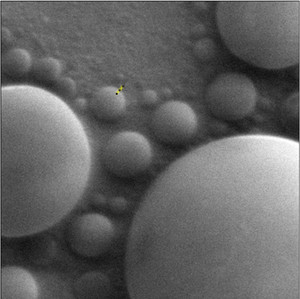
Researchers from CIMAP (Joint research unit UMR CEA, CNRS, Université de Caen, ENSICAEN), have demonstrated the feasibility of a new ion source using molten salt emitted through a glass microcapillary. This proof of concept shows that a single source can produce ion beams in both positive and negative polarity thanks to an original “closed” architecture. The study also sheds light on several physical phenomena that affect the source’s operation and identifies ways to improve its stability, with potential applications including Secondary Ion Mass Spectrometry (SIMS).
The performance of Secondary Ion Mass Spectrometry (SIMS) largely depends on the characteristics of the primary ion source used to bombard the sample. Existing technologies each have their own advantages and limitations: some provide excellent brightness and low energy spread but can emit only a limited range of ion species, while others deliver ions better suited to specific analyses at the cost of greater complexity or limited stability. Developing a source that combines the optical performance of today’s best ion sources with reactive ion species, while operating in both positive and negative polarity, is therefore an important challenge for future advances in SIMS.
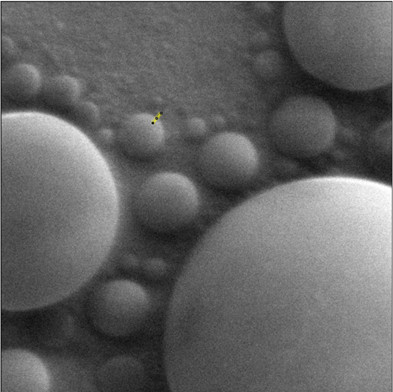
Figure 1: Secondary electron image acquired with a Cs⁺ primary ion beam at 10 keV and 9 pA. Field of view: 20 µm.
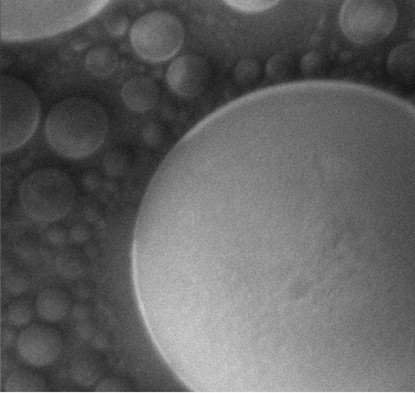
Figure 2: Secondary electron image acquired with a NO₃⁻ primary ion beam at 10 keV and 6 pA. Field of view: 20 µm.
To address this challenge, the researchers designed an original source based on a molten-salt mixture rich in cesium and oxygen ions, contained within a glass microcapillary. Under an intense electric field, the liquid forms an electrically stressed meniscus with a geometry close to that of a Taylor cone, from which ions are extracted. Unlike conventional “open” architectures based on a metallic needle coated with liquid, this “closed” design confines the salt inside the capillary. It is intended to overcome limitations in the liquid supply to the emitter tip while reducing the surface area of molten salt exposed to vacuum. The researchers also showed that inserting a thin alumina fiber into the capillary can compensate for the poor wetting of glass by the molten salt, help transport the liquid to the capillary tip and maintain electrical continuity within the liquid, two essential conditions for proper source operation.
Experimental tests produced stable ion emission of around 2 µA in both positive and negative polarity, with a drift of less than 1% per hour, compatible with industrial operating conditions. Figures 1 and 2 show the source’s imaging performance in positive-ion (Cs⁺) and negative-ion (NO₃⁻) emission modes at 10 keV, with spatial resolutions of 80 nm and 65 nm, respectively. At 30 keV, the imaging resolution can reach as low as 20 nm.
Using a camera integrated into the experimental setup, the researchers were able to directly observe the formation of bubbles caused by residual moisture in the salt, as well as changes in the anchoring point of the liquid meniscus during ion emission. These observations helped identify additional factors likely to affect source stability, including temperature, liquid supply and the wetting properties of the molten salt. The paper indeed reports that residual moisture produces submillimeter-sized bubbles and that the anchoring point of the electrically stressed meniscus changes over time.
Beyond this proof of concept, the study provides a better understanding of the molten-salt properties that govern the operation of an ion source under vacuum. In particular, it highlights the roles played by hygroscopicity, glass wetting, liquid supply to the emitter tip and meniscus stability. The researchers suggest several avenues for improvement, including modifying the inner surface of the capillary to enhance salt wetting and handling the source under a controlled atmosphere to minimize moisture uptake. These results represent an important step towards the development of more versatile ion sources for SIMS. They pave the way for further optimization of this architecture to improve its stability and explore its potential for applications requiring highly focused ion beams.
Reference
Molten salt ion source using glass capillaries as emitter
M. Leger, Eric Giglio, S. Guillous, A. Houel. Condensed Matter – Materials Science, 2026.
Collaboration
- Orsay Physics, TESCAN Group.
Contact
- Stéphane Guillous, Researcher at Centre de recherche sur les Ions, les MAtériaux et la Photonique – CIMAP.