

At CIMAP, investigating the biological responses to ultra-high dose rate irradiation sheds new light on the still elusive mechanisms underlying the FLASH effect, opening promising avenues for cancer radiotherapy.
FLASH radiotherapy, based on ultra-high dose rates (UHDR, >50 Gy/s), has attracted growing attention due to its ability to spare healthy tissues while preserving tumour control. However, the mechanisms driving this effect remain poorly understood, especially at even higher dose rates. A key scientific bottleneck lies in the scarcity of experimental data spanning a broad range of dose rates and integrating multiple biological endpoints.
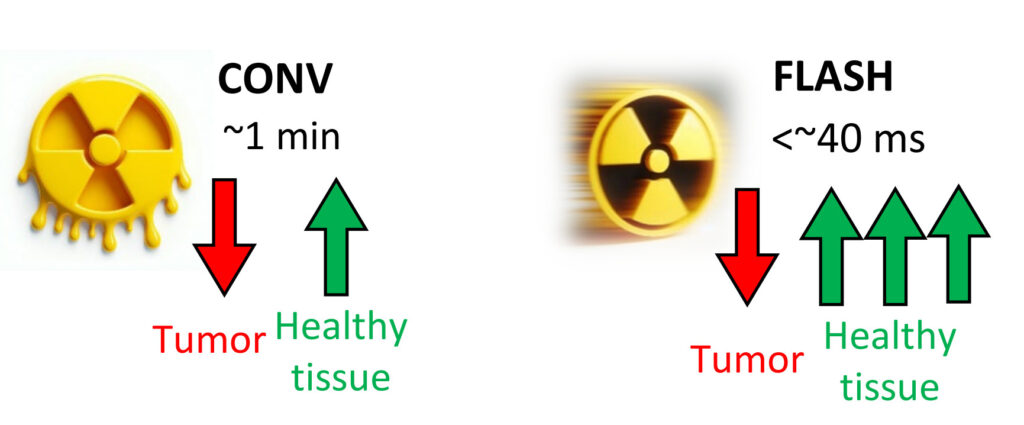
In this in vitro study, brain (glioblastoma U251) and lung (carcinoma A549) cancer cell lines, along with their corresponding healthy counterparts, were irradiated using a proton beam over a wide range of dose rates, from 4 Gy/min to 1250 Gy/s, and doses from 2 Gy to 10 Gy. Results show that cancer cell survival decreases at the highest dose rates, particularly at 1250 Gy/s, suggesting a potentially increased therapeutic gain. Cell cycle analysis further reveals that healthy cells show a stronger cell-cycle arrest in the G2 phase, a response often associated with DNA damage repair, independent of dose rate but increasing with dose.
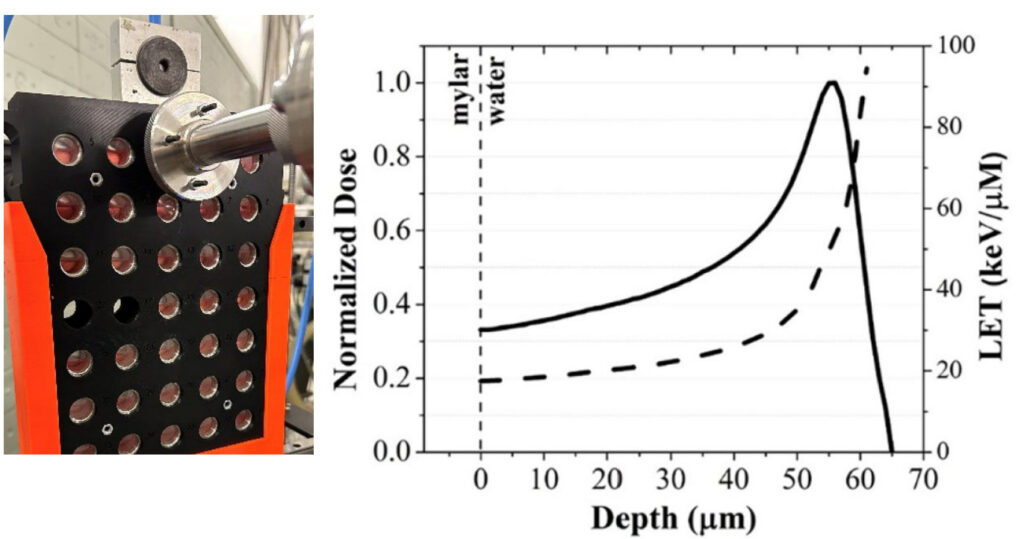
Configuration d’irradiation et courbe profondeur-dose avec LET
A key contribution of this work lies in the analysis of Reactive Oxygen Species (ROS) formation. The results show that ROS levels were highest at the conventional dose rate (4 Gy/min), with a decrease as dose rate increased. Moreover, ROS production was consistently higher in healthy cell lines than in tumour cells. These findings suggest that ROS modulation may contribute to mechanisms involved in the FLASH effect.
Overall, this study provides new insights into the biological mechanisms underpinning the FLASH effect across a wide range of dose rates. It highlights a potential enhancement of therapeutic gain at extreme UHDR while emphasizing the complexity of the associated cellular processes. These results pave the way for further investigations aimed at optimizing irradiation parameters in FLASH radiotherapy, with the longer-term objective of optimizing FLASH radiotherapy strategies.
Reference
“In vitro flash effect as a function of ultra-high dose rates with proton beam”, Mihaela Temelie, Mateusz Sitarz, Mihaela Tudor, Kilian Lecrosnier, Mihai Radu, Diana Savu, François Chevalier, International Journal of Particle Therapy 17 (2025) 101053 – hal-05397419.
Collaboration
Contact CEA
- CIMAP : François Chevalier, Kilian Lecrosnier
- LIDYL : Gérard Baldacchino