



 |  © photo: D.Touzeau/CEA |
| Study of new concepts for miniaturizable and parallelizable liquid-liquid extractors |
Background
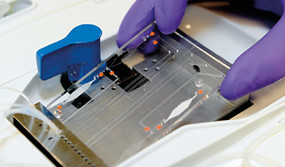
This thesis aims to study in detail microfluidic concepts designed to mix two-phase liquids. Such circuits are very important processes in the chemical industry since they are used in a variety of industrial sectors from biotechnology to nuclear fuel reprocessing. This circuit is based on an innovative concept in the field and involves in particular the formation and oscillation of liquid plugs surrounded by another liquid in a capillary, and the resulting thermal and chemical transfers. However, such flows are still poorly understood, even in the absence of chemical reactions. In addition, the great simplicity of implementation of the process is offset by difficulties in controlling it, limiting its use on large volumes.
Scientific Objectives
The doctoral student will study fundamental phenomena of two-phase flow in a capillary in the presence of slow pressure oscillations imposed at its ends. The aim is to understand the appearance of plugs, or Taylor bubbles, from annular flow where the walls are covered with a liquid and surround another liquid in the center. In this system, plugs separated by bubbles form spontaneously due to an instability known as Plateau-Rayleigh instability. As the bubbles move along the capillary, a liquid film forms, separating the bubbles from the wall. These phenomena are key to better understanding, modeling, and ultimately facilitating the control of the liquid-liquid extraction chemical process. Based on current experimental and functional achievements and theoretical studies at two CEA institutes, the Institute for Science and Technology for a Circular Economy of Low-Carbon Energies (ISEC) at CEA/Marcoule, where the doctoral student will be based, and the Institute of Radiation and Matter at CEA/Paris-Saclay (IRAMIS), we wish to:
- Understand and phenomenologically model flow in both regimes and the transition between them
- Experiment with and model the mass exchange
- Optimize the process and its control for upscaled devices
Candidate Profile
- Generalist profile in physical chemistry, chemical physics, fluid dynamics, chemical engineering
- Strong interest in experimentation
- Creative and independent thinker
Advantages for the candidate
- Introduction to the world of research in a multidisciplinary team with extensive expertise that values the quality of supervision provided to its doctoral students
- Experience in a project spanning research and industry
- Experience in an institution that is a major player in the research of the circular economy of low-carbon energies
Contact
- Alastair Magnaldo (ISEC)
- Vadim Nikolayev (IRAMIS)
Build today the society of tomorrow