




Detecting extremely weak microwave signals is a key challenge across several fields of research, from quantum computing to the study of magnetic properties at the atomic scale. Yet even the most sensitive detectors available today remain constrained by a fundamental limit known as the Standard Quantum Limit (SQL). The SUPERQuSENSE project aims to explore the potential of a technology capable of overcoming this limit by counting microwave photons one by one, while paving the way for its broader adoption by scientific and industrial users.
From the Laboratory to Future Scientific and Industrial Applications
Emmanuel Flurin, researcher at the Condensed Matter Physics Department – SPEC, a joint CEA-CNRS research unit, has received an ERC Proof of Concept (PoC) grant for his project SUPERQuSENSE. This European funding scheme is designed to support the maturation and valorisation of results emerging from ERC-funded research.
The project builds on a technology developed through his ERC Starting Grant INGENIOUS: the Single Microwave Photon Detector (SMPD), a quantum device capable of counting individual microwave photons, the elementary particles that carry electromagnetic signals at microwave frequencies.
Developed using superconducting circuits derived from quantum technologies, the detector achieves a sensitivity beyond that of conventional microwave detectors and can overcome the Standard Quantum Limit that currently constrains the detection of extremely weak signals. While conventional detectors measure an overall signal, the SMPD can directly detect microwave photons one at a time.
Measuring extremely weak microwave signals is a bit like trying to hear a whisper amid the background noise of the quantum vacuum. By counting photons one by one directly based on a small quantum processor operating at GHz frequencies, we change the very way these signals are detected: this makes it possible to silence quantum fluctuations and reveal signals that were previously inaccessible. With SUPERQuSENSE, the goal is now to turn this scientific breakthrough into an instrument that can be used by other laboratories and to develop its future industrial applications.
Emmanuel Flurin, SPEC researcher and coordinator of the SUPERQuSENSE project
Performance Enabling New Measurement Capabilities
The SMPD has already enabled several significant scientific breakthroughs, including the first microwave-based detection of an individual electron spin and a substantial acceleration of axion dark matter search experiments.
With SUPERQuSENSE, the goal is now to assess the potential of this technology beyond the research environment in which it was developed. The project will support a range of activities, including market analysis of potential application areas, a freedom-to-operate study, the development of dedicated control software and electronics, and the collection of feedback from international laboratories and industrial partners that will beta-test several SMPD systems.
These efforts will also support the preparation of Qudigy, a future spin-out company led by three PhD graduates trained within Emmanuel Flurin’s research team, with the ambition of bringing this technology to academic and industrial users.
SUPERQuSENSE illustrates how advances in fundamental research can gradually give rise to entirely new scientific instruments. Building on several years of research in quantum physics and the results achieved through the ERC INGENIOUS project, it aims to define the next steps needed to assess the technology’s adoption potential and prepare its wider dissemination within the scientific and industrial communities.

Figure: Illustration of the operating principle of SUPERQuSENSE: a quantum electromagnetic signal is detected by the sensor. This sensor, a small quantum processor comprising two qubits, digitises the quantum signal into a sequence of 0s and 1s. This detection principle, which is immune to quantum noise, enables a significant increase in sensitivity to very weak electromagnetic signals, whether they originate from an electron spin, a quantum computer or a signature of galactic dark matter.
À propos d’Emmanuel Flurin
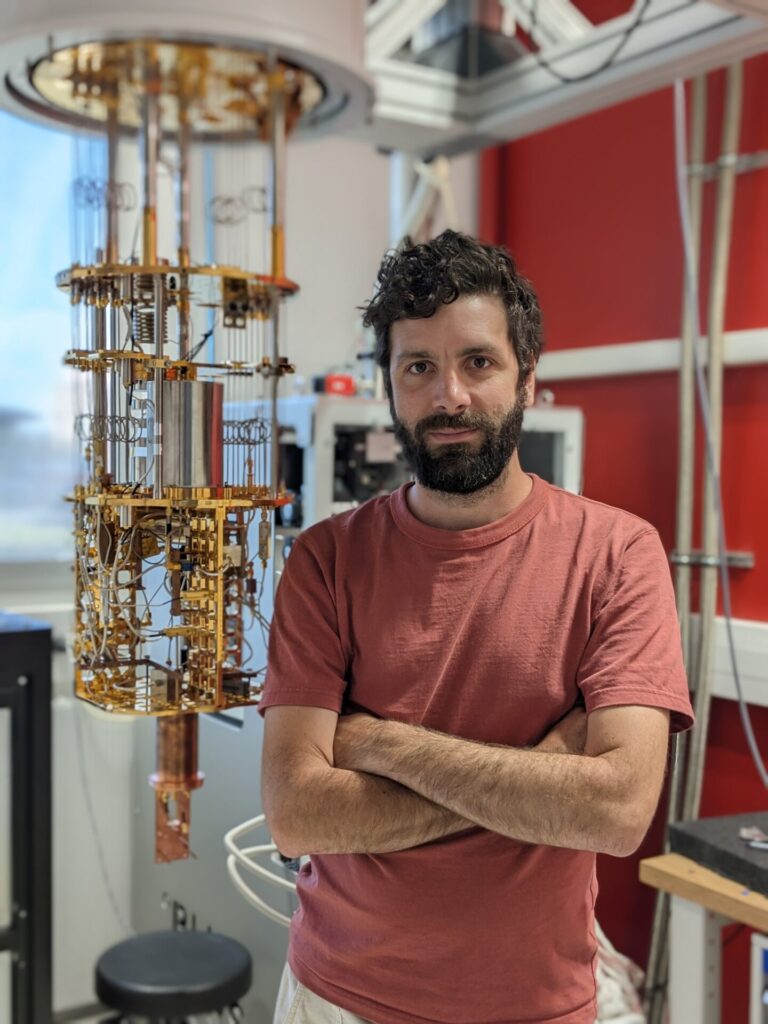
Emmanuel Flurin is a researcher at CEA’s Fundamental Research Division (DRF), where he conducts his work at IRAMIS within the Condensed Matter Physics Department – SPEC, a joint CEA-CNRS research unit.
Specialist in superconducting quantum circuits, he develops new architectures for quantum computing, quantum communication and next-generation quantum sensing. As part of his ERC Starting Grant INGENIOUS (2022-2027), he led the development of the Single Microwave Photon Detector (SMPD), a technology that notably enabled the first microwave-based detection of an individual electron spin and opened new possibilities for measuring extremely weak
microwave signals. Inventor or co-inventor of the patents associated with this technology, Emmanuel Flurin is also actively involved in its transfer toward future applications in collaboration with CEA’s innovation teams. In 2026, he was named among the 100 Inventors of 2026 of Le Point, which celebrates “women and men who rely on science and fundamental research to change the world”.