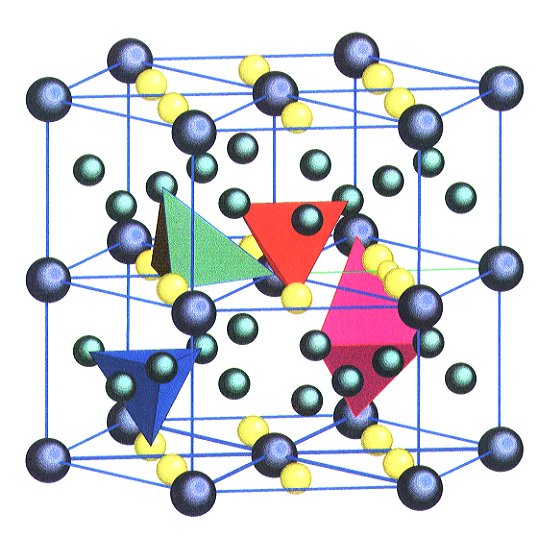

Phase Transitions: One of the central questions in condensed matter physics concerns phase transitions between metallic, insulating, and superconducting states in materials where electronic correlations are predominant. These phase transitions are accompanied by breaks in structural and/or magnetic symmetry that provide insight into the microscopic mechanisms underlying the electronic correlations and the remarkable properties of these compounds. IRAMIS develops cutting-edge techniques to detect and precisely characterize phase transitions in materials by neutron or X-ray scattering.
Extreme conditions: Extreme conditions (magnetic fields, pressure, low temperatures, or high energy density) give rise to new and interesting effects, the study of which provides insights into the properties of matter at great depths or in the cores of giant gas planets. Compounds as simple and abundant as hydrogen and oxygen develop unusual magnetic, metallic, or even superconducting phases under high pressure and at very low temperatures. In pressurized solid oxygen, the structure is stabilized by magnetic couplings whose strength is comparable to weak intermolecular interactions.