



How can we break down PFAS, often referred to as “forever chemicals”, which can contaminate water for long periods? At NIMBE (a joint CEA–CNRS research unit), scientists from the LEDNA and LCMCE groups have explored an unusual approach: using tiny diamond particles and light to break down one of these pollutants, PFOA. In laboratory experiments, they succeeded in releasing almost all the fluorine contained in the molecule as fluoride ions. The findings offer a promising avenue for developing treatments that break down certain persistent pollutants rather than simply trapping them in filters.
PFAS are found in a wide range of everyday products, including certain textiles and food packaging, where they are valued for their resistance to water, grease and heat. But these useful properties come with a significant drawback: once released into the environment, these substances are extremely difficult to break down. Their persistence is partly due to the exceptionally strong chemical bonds between the carbon and fluorine atoms that make up their molecules. Current methods for removing PFAS from water, such as filtration or capture using materials like activated carbon, can trap these substances without actually destroying them. How, then, can these particularly strong bonds be broken? This is one of the questions researchers are seeking to address by exploring ways to degrade these pollutants using light.
The NIMBE team turned to an unexpected material: diamond, in the form of extremely small particles known as nanodiamonds. These particles have distinctive properties that allow them to participate in chemical reactions when exposed to light. The researchers compared several types of nanodiamonds, produced using different methods and with surfaces modified through either oxidation or hydrogen treatment. They suspended the particles in water containing PFOA, then exposed the mixture to a lamp producing solar-type illumination. By regularly analysing the water, they tracked not only the disappearance of PFOA but also the substances formed as it broke down.
The results show that not all nanodiamonds behave in the same way. Those with hydrogen-treated surfaces proved active, particularly when produced by milling diamond crystals. Under the most favourable conditions tested, the original PFOA disappeared in less than 40 minutes. But making a molecule disappear does not necessarily mean it has been completely broken down: it may simply have been converted into other substances, some of which still contain fluorine and could be just as problematic for the environment. To establish what was actually happening, the researchers also measured the amount of fluorine released as fluoride ions. After approximately 100 minutes, this accounted for almost all the fluorine originally present in the PFOA. Another encouraging finding was that the same nanodiamonds could be reused four times without any significant loss of their ability to degrade the pollutant.
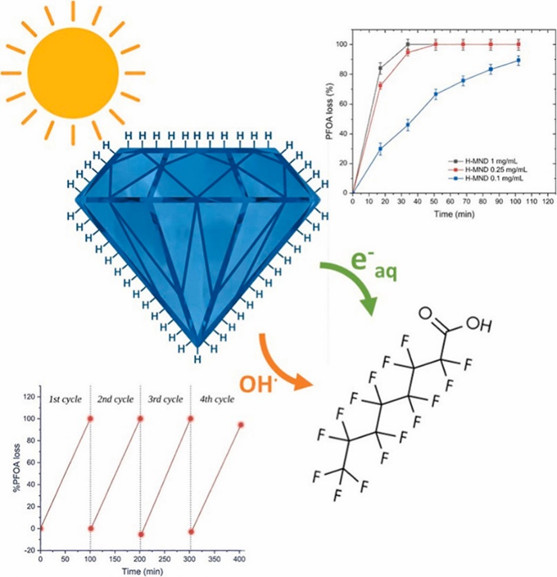
What makes these nanodiamonds so effective? The analyses show that PFOA gradually breaks down into molecules with progressively shorter carbon chains. Other detected products also suggest that some fluorine atoms are replaced by groups containing oxygen and hydrogen, although their precise identification still requires confirmation. Two properties of the nanodiamonds appear to favour these transformations. First, their surfaces have a stronger affinity for PFOA molecules, bringing them into closer contact. Second, their electronic properties allow them to release highly reactive electrons when exposed to light, potentially helping to break the strong carbon-fluorine bonds. Further experiments are needed, however, to better understand this mechanism. The study therefore highlights the importance of both how nanodiamonds are produced and how their surfaces are prepared.
Finally, the researchers showed that the degradation process does not necessarily require the most energetic ultraviolet radiation, which is generally absent from sunlight reaching the Earth’s surface. PFOA can also be broken down, albeit more slowly, using wavelengths present in sunlight (UV A and B). The nanodiamonds also remain effective when oxygen is present in the water. These properties make hydrogenated nanodiamonds an interesting avenue for developing treatments that break down certain persistent pollutants rather than simply capturing them. Before any application to water treatment can be considered, however, their effectiveness will need to be tested under natural sunlight and in real contaminated water, at concentrations representative of environmental conditions. This study thus helps improve our understanding of how the properties of a carbon-based material can be harnessed to tackle molecules that are particularly difficult to break down.
Reference
Rafaël Jimenez, Caroline Genre, Charlène Boillereau, Sophie Peulon, Jean-Charles Arnault et Hugues A. Girard.
« Standalone nanocarbon photocatalyst for a complete and fast photodegradation of PFOA to fluorine ions under solar-type illumination ». Carbon, 260 (2026).
Contact
- Hugues Girard and Jean-Charles Arnault, researchers at Laboratoire Édifices Nanométriques – LEDNA at NIMBE.