


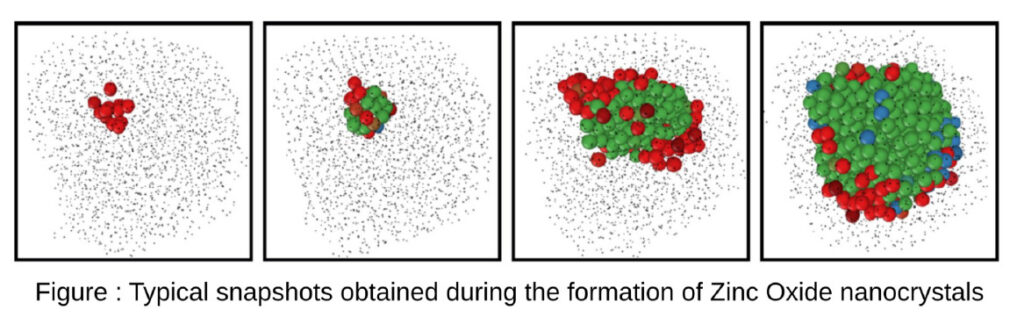
While nanocrystals in material science are ubiquitous, the mechanisms of their formation which span from nucleation to crystal growth remain one of the most intriguing processes in nature. Better understanding crystallization in general would allow for a rational control of material engineering and possibly the development of novel functional materials and technological applications. From the experimental viewpoint, numerous works have been dedicated to elucidating nucleation by observing the intricate relationship between experimental conditions and final structures. Yet, even if numerical simulations should have been a pivotal instrument to investigate crystallization in nanoparticles, studying nucleation requires large scale simulations that were so far too computationally demanding to achieve. As such, most works based on simulations have only focused on simple model materials thus preventing from targeting specific technological applications.
In this presentation, we will introduce innovative numerical tools based on machine-learning approaches and show how they can be employed to probe the nucleation processes in more complex materials. In particular, we will present results obtained for three different types of nanoparticles namely oxides, nanoalloys and hydrogen covered metals.
References
[1] Q Gromoff, P Benzo, WA Saidi, CM Andolina, MJ Casanove, T Hungria, S Barre, M Benoit, J Lam Nanoscale 16 (1), 384-393
[2] CR Salazar, AK Ammothum Kandy, J Furstoss, Q Gromoff, J Goniakowski, J. Lam npj Computational Materials 10 (1), 199
[3] Q. Gromoff, M. Benoit, J. Goniakowski, C. R. Salazar, J. Lam Nanoscale https://doi.org/10.1039/D5NR04147C