

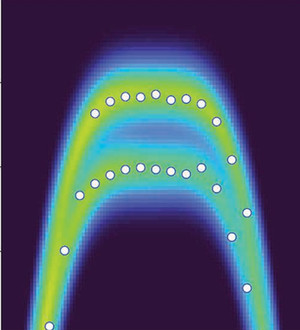
Magnetism goes far beyond the familiar magnets we encounter in everyday life. Some materials exhibit much subtler magnetic properties that are equally fascinating to explore. By studying manganese fluoride, a material that has been investigated for decades, researchers from the Laboratoire Léon Brillouin (Joint unit CEA–CNRS), in collaboration with the Laboratoire de Physique des Solides, Oak Ridge National Laboratory and the University of Windsor, have demonstrated that it exhibits a particular form of magnetism known as altermagnetism, whose signatures had previously been difficult to detect. Beyond this specific material, their findings provide new ways to identify subtle magnetic properties that could, in the longer term, be relevant to the development of future electronic technologies.
When we think of magnetism, we usually picture a magnet attracting metal objects. Yet not all magnetic materials behave this way. In some materials, atoms carry tiny magnetic moments, much like miniature compass needles, that point in opposite directions. These moments cancel each other out, leaving the material with no net magnetization. This phenomenon is known as antiferromagnetism. However, this apparent cancellation can conceal more subtle magnetic properties. In materials known as altermagnets, the particular arrangement of atoms and their magnetic moments within the crystal gives rise to properties that distinguish them from conventional antiferromagnets. Manganese fluoride (MnF₂), studied since the 1960s as a textbook example of antiferromagnetism, is a particularly interesting case: its crystal symmetry is compatible with altermagnetism, but the signatures needed to identify it are extremely weak.
To uncover these subtle effects, the researchers investigated how magnetic moments move within the material. Rather than remaining perfectly still, they can oscillate collectively, producing what physicists call spin waves. To probe these microscopic excitations, the team used a technique known as inelastic neutron scattering. This involves directing a beam of neutrons at a crystal and analysing how the neutrons interact with its magnetic excitations. The experiment was carried out at very low temperatures on a single crystal of MnF₂, using an instrument capable of resolving extremely small energy differences. The researchers also employed polarized neutrons, whose spin orientation can be controlled, to gain further insight into the nature of these magnetic oscillations.
The initial measurements revealed a feature that had escaped earlier experiments: what previously appeared to be a single spin-wave branch actually consists of two closely spaced modes with slightly different energies. The maximum energy splitting is remarkably small, approximately 0.18 millielectronvolts. However, this observation alone is not sufficient to establish altermagnetism. The researchers showed that the splitting arises primarily from well-known long-range magnetic dipolar interactions, which can produce such an effect independently of altermagnetism. Identifying the material’s true magnetic character therefore required looking beyond the energy difference between the two modes.
This is where polarized neutrons proved decisive. By comparing measurements taken with opposite neutron polarizations, the researchers isolated a distinctive signal associated with the chirality of the spin waves, a property related to the sense in which magnetic moments rotate as they oscillate. Crucially, this chiral signal reverses sign between the two observed modes. Theoretical calculations showed that the dipolar interactions responsible for most of the energy splitting cannot, on their own, account for this response. Instead, the signal reflects a subtle feature of the crystal’s magnetic symmetry. This experimental signature provides compelling evidence that MnF₂ is indeed altermagnetic, even when the characteristic effects of this magnetic order are exceptionally small.
Beyond manganese fluoride, these findings shed new light on the diversity of magnetic behaviour in matter. They demonstrate how more sensitive experimental techniques can reveal properties that conventional measurements may fail to detect. The ability to identify and understand these subtle forms of magnetism is essential for investigating other materials and gaining a deeper understanding of their properties. In the longer term, this knowledge could also be relevant to spintronics, a field of research that seeks to harness electron spin, an intrinsic property responsible for their magnetic behaviour, in electronic devices. Although this study does not demonstrate any immediate technological application, it advances both the fundamental understanding and the experimental tools needed to investigate materials whose magnetic properties may eventually prove useful in future technologies.
Reference
Quentin Faure, Dalila Bounoua, Victor Balédent, Arsen Gukasov, V. Ovidiu Garlea, Afonso Ribeiro, Jeffrey G. Rau, Sylvain Petit, Paul Mc Clarty. « Altermagnetism revealed by polarized neutrons in MnF₂ ». Science, 2026.
Collaboration
- Laboratoire de physique des solides – LPS (UMR Paris Saclay University – CNRS), France.
- Oak Ridge National Laboratory, United-States.
- University of Windsor, Canada.
Contacts
- Sylvain Petit & Paul Mc Clarty, researchers at LLB.