

Researchers at Quantronics group at SPEC (Joint Reserach Unit UMR CEA-CNRS), in collaboration with Laboratoire de Physique de l’École Normale Supérieure – LPENS (UMR ENS, CNRS, Sorbonne Université, Université Paris Cité), have theoretically investigated heat and charge transport through a chain of small metallic islands connected by ballistic channels. Their calculations reveal that electron interactions give rise to a collective mode that carries energy without carrying net electrical charge. In long chains, this mechanism enhances heat transport relative to electrical transport, breaking the usual relationship between the two described by the Wiedemann-Franz law.
In ordinary metals, electrons carry both electrical charge and heat. The two are therefore generally linked by the Wiedemann-Franz law: at low temperatures, electrical and thermal conductance are related by a universal ratio. Strong electron interactions can, however, break this relationship. Such effects are already known in simple quantum systems, including a single metallic island. But what happens when several islands are connected together? How these interaction effects evolve when scaling up to a chain of islands remains largely unexplored.
To address this question, the researchers developed a theoretical model of a chain of small metallic islands placed between two reservoirs held at different temperatures. The islands are connected by ballistic channels, along which electrons propagate without backscattering. At very low temperatures, Coulomb interactions prevent the charge on each island from fluctuating freely, placing the system in the heat Coulomb blockade regime. The researchers then used the model to calculate how heat and charge are transported through the chain as the number of islands increases.
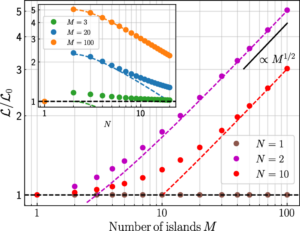
Their calculations reveal a specific transport mode that emerges only in chains of at least two islands. This “split” neutral mode carries energy without carrying net electrical charge. Unlike local heat exchange between neighbouring islands, it involves long-range correlations between the islands’ charge states and contributes to energy transport towards the source and drain at either end of the chain, without any energy absorption by intermediate islands. In a long chain with multiple channels, the heat flow therefore decreases as the inverse square root of the number of islands, rather than inversely with their number as in the non-interacting diffusive regime. Heat is thus transported more efficiently than would be expected in the absence of interactions.
Electrical transport, by contrast, is unaffected by these interactions and continues to decrease with chain length. As the chain grows, heat and charge transport therefore become increasingly decoupled: the Wiedemann-Franz law breaks down, with the ratio of thermal to electrical transport increasing as the square root of the number of islands. This behaviour contrasts with that of a single island, where heat Coulomb blockade instead suppresses heat transport. Connecting several islands therefore gives rise to collective behaviour that is absent in an isolated component. The breakdown of the Wiedemann-Franz law provides an experimentally measurable signature of this collective physics.
These theoretical results provide predictions that can be confronted with experiment. For experimentally realistic configurations containing up to around thirty islands, the calculated heat flows range from 0.01 to 1 femtowatt, challenging, but realistically measurable according to the authors. The model could also be extended to other configurations, including two-dimensional arrays and fractional edges. This also points to opportunities to investigate equilibration processes and, in suitably adapted configurations, entropy signatures.
Reference
Patrice Roche, Carles Altimiras, François D. Parmentier, Olivier Maillet. Breakdown of the Wiedemann-Franz Law in an Interacting Quantum Hall Metamaterial. Physical Review Letters 136, 196301 (2026).
Collaboration
- Laboratoire de Physique de l’École Normale Supérieure – LPENS (UMR ENS, CNRS, Sorbonne Université, Université Paris Cité), France.
Contact
- Olivier Maillet, researcher at Quantronics group au SPEC.