

Researchers from the Quantronics group at SPEC (Joint research unit UMR CEA-CNRS), working with the Sherbrooke University, the Chinese University of Hong Kong, Chimie ParisTech – PSL, l’IM2NP et l’Institut Néel (CNRS), have shown that a spectral pattern created by microwaves in an erbium-doped crystal can persist for more than a week when cooled to 10 millikelvin. Until now, maintaining such spectral patterns over long periods has been particularly challenging in comparable paramagnetic systems. By revealing an exceptionally stable regime at ultralow temperatures, this work opens new avenues for studying rare-earth-ion-doped crystals and their use in information processing and storage.
Rare-earth ions have optical and magnetic properties that make them particularly attractive for information-processing applications. When embedded in a crystal, a small subset of these ions can be selectively addressed according to their resonance frequency, and their population modified using microwaves. This creates a “spectral hole”, i.e. a highly localised change in the material’s response at a given frequency. The challenge is to preserve this spectral imprint for long enough. While lifetimes of several days or even weeks have already been achieved in some non-paramagnetic rare-earth systems, they have so far been much shorter in the paramagnetic systems studied, ranging from a few seconds to around one minute.
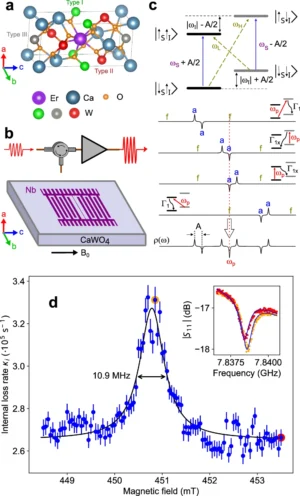
To overcome this limitation, the researchers studied a calcium tungstate (CaWO₄) crystal containing a very low concentration of erbium ions, around 3 parts per billion, and cooled it to 10 mK, just 0.01 K above absolute zero. Using a superconducting resonator, they excited the erbium electron spins with microwaves. The key to the effect lies in their interaction with the nuclear spins of neighbouring tungsten-183 (183W) atoms. The state of these nuclear spins act as auxiliary levels, allowing the modified spectral profile to persist for remarkably long periods.
The researchers also showed that repeatedly applying pairs of microwave pulses creates a periodic structure across the spectrum. When subsequently excited by a microwave pulse, this structure emits delayed microwave pulses known as “accumulated echoes”, a phenomenon similar to that exploited in atomic frequency combs investigated for certain quantum-memory protocols. Crucially, the lifetime of these spectral structures increases dramatically as the temperature is lowered. At 10 mK, the echoes remain measurable after six days, while analysis of their decay reveals a slow component with a time constant of around one month.
The experiments also provide insight into the origin of this remarkable stability. Close to an erbium ion, some tungsten nuclear spins become almost isolated from their surroundings and therefore relax extremely slowly, an effect known as the “frozen core” effect. The measurements further indicate that the resonance frequency of most erbium ions drifts by less than 10 kHz over one month at 10 mK, revealing extremely weak spectral diffusion at this temperature.
Beyond these exceptionally long lifetimes, the study highlights millikelvin temperatures as a largely unexplored and particularly promising regime for rare-earth-ion applications. The persistence of these spectral structures could benefit information-processing and storage protocols, including in the quantum domain. Significant improvements are nevertheless still required to implement a quantum memory, in particular by increasing the spectral modulation and the coupling between the spin ensemble and the resonator. This study therefore represents a fundamental step towards understanding and controlling highly stable spin systems at millikelvin temperatures.
Reference
Zhiren Wang, Sen Lin, Marianne Le Dantec, Miloš Rančić, Philippe Goldner, Sylvain Bertaina, Thierry Chaneliere, Renbao Liu, Daniel Esteve, Denis Vion, Emmanuel Flurin & Patrice Bertet. Week-long-lifetime microwave spectral holes in an erbium-doped scheelite crystal at millikelvin temperature. Nat Commun 16, 9032 (2025).
Collaboration
- Université de Sherbrooke, Canada.
- Chinese University of Hong Kong, Hong Kong.
- Chimie ParisTech-PSL, France.
- Institut Matériaux Microélectronique Nanosciences de Provence- IM2NP (UMR CNRS 7334, Aix-Marseille Université, Univ. de Toulon), France.
- Institut Néel, CNRS, France.
Contact
- Patrice Bertet, researcher at Quantronics group at SPEC.