

Researchers from the Laboratoire d’Archéomatériaux et Prévision de l’Altération – LAPA at NIMBE (UMR CEA-CNRS), have developed a novel approach to characterize long-term atmospheric corrosion layers formed on historical iron samples aged over 500 years. By combining Raman spectroscopy with advanced chemometric methods, they demonstrate that corrosion phases can be reliably identified and spatially mapped without relying on experimentally acquired reference spectra. This study provides a new framework for investigating complex long-term corrosion systems.
The corrosion of metals leads to the formation of complex corrosion product layers, whose structure and composition depend on environmental conditions (humidity, temperature, pollution, presence of chlorides, etc.). Their characterization is essential for understanding corrosion mechanisms and assessing the protective character of these layers. However, this analysis remains challenging: multiple phases coexist at the micrometric scale, some are poorly crystallized, and their spectral signatures overlap, making their identification difficult using conventional data processing methods.
To address this issue, Raman hyperspectral images were acquired on two historical samples aged over five centuries: outdoor-exposed low-alloy steel clamps from Metz Cathedral and indoor-exposed iron reinforcements from Amiens Cathedral. These datasets were processed using Multivariate Curve Resolution – Alternating Least Squares (MCR-ALS), which enables the decomposition of the signals into spectral contributions associated with the different crystalline phases and their spatial distribution within the corrosion product layers.
To evaluate the robustness of the method and the influence of the MCR-ALS initialization strategy, two approaches were compared: one based on experimentally acquired reference spectra, and the other relying on spectral components automatically extracted from the data using Non-negative Matrix Factorization (NMF), without the use of experimental reference spectra.
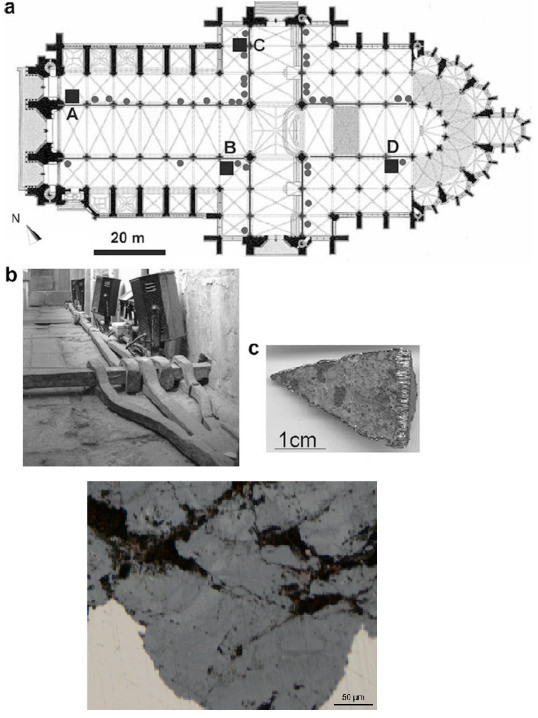
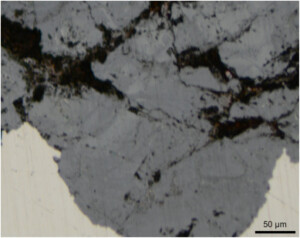
a) View of the Triforium reinforcing chain in Amiens cathedral; b) Green lines indicate its arrangement around the building; c) Example of collected sample; d) Optical image of the studied zone on the Amiens cathedral’s sample.
The results show that this second approach, based on blind initialization via NMF enables the identification of the same corrosion phases as the reference-based approach, with consistent spatial distributions between both methods. These results are also consistent with those reported in the literature for similar corrosion systems. The approach allows effective identification of the typical phases of atmospheric corrosion, as well as their distribution within the corrosion product layers. It also reveals the presence of phases such as magnetite and hematite in the Metz sample, identified like a hot forging oxide layer, known as mill scale, remaining from the elaboration process of the staple.
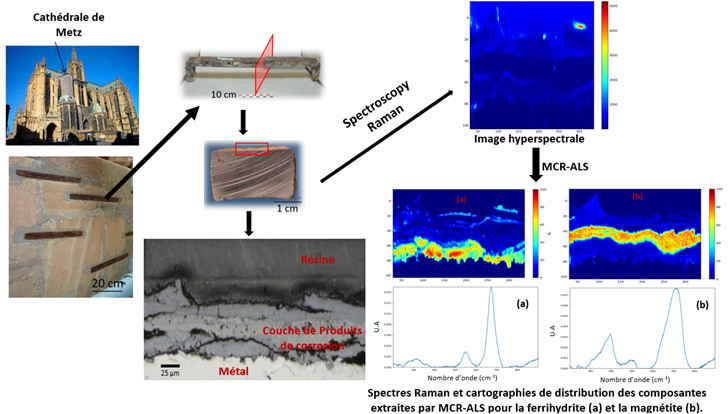
Example of results obtained by MCR-ALS analysis of Raman data acquired from a sample collected from an iron clamp at Metz Cathedral.
Ces résultats montrent par ailleurs qu’il est possible de caractériser de manière robuste des systèmes de corrosion particulièrement complexes sans recourir à des spectres de référence expérimentaux préalables. En facilitant l’exploitation de grands ensembles de données Raman, cette méthodologie constitue un outil pertinent pour l’étude des mécanismes de corrosion atmosphérique à long terme. Elle contribue ainsi à une meilleure compréhension de l’évolution des matériaux ferreux anciens, avec des applications pour la conservation du patrimoine et l’évaluation de la durabilité des matériaux sur de longues échelles de temps.
Reference
Characterization of long-term atmospheric corrosion of iron in indoor and outdoor conditions using Raman spectroscopy coupled to multivariate curve resolution-alternating least squares
Faten Ammari, Robin Le Penglau, Mickaël Bouhier, Delphine Neff. Talanta, 2026, 305, pp.129569.
Collaboration
- IRAMAT-LAPA de l’IRAMAT (UMR 7065 CNRS – Université Orléans – Université de Technologie de Belfort-Montbéliard – Université Paris-Saclay).
Contact
- Faten Ammari et Delphine Neff, chercheuses au Laboratoire Archéomatériaux et Prévision de l’Altération – LAPA au NIMBE.