

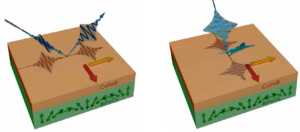
Researchers from the Service de Physique de l’État Condensé (SPEC – CEA), in collaboration with the Laboratoire Albert Fert (CNRS-Thales), the SPMS Laboratory (CentraleSupélec-CNRS), have demonstrated for the first time that an ultrafast spin current can efficiently transfer spin angular momentum into an insulating antiferromagnet (AF) and trigger its coherent terahertz magnetic excitations. This breakthrough overcomes a major challenge in ultrafast spintronics and opens new opportunities for manipulating magnetic information at terahertz frequencies.
Antiferromagnetic (AF) materials are emerging as promising building blocks for next-generation spintronic devices, which exploit the electron’s spin rather than its charge to process information. Unlike ferromagnets, their magnetic moments are antiparallelly arranged, cancelling out any net macroscopic magnetization. This feature makes antiferromagnets inherently robust against external perturbation while enabling an intrinsic magnetic dynamic at terahertz frequencies (1 THz = 1012 Hz). Despite these attractive properties, the direct injection of ultrafast spin current, capable of exciting antiferromagnetic order on picosecond timescales (10-12 s), was yet to be demonstrated. This remained particularly challenging because antiferromagnetic excitations are extremely difficult to detect in thin films.
To address this challenge, a heterostructure consisting in a thin CoFeB ferromagnetic layer deposited on an insulating BiFeO3 antiferromagnetic multiferroic film was investigated using ultrafast time-resolved optical and magneto-optical measurements. Ultrafast spin current pulses were generated by illuminating the ferromagnetic layer with femtosecond (10-15 s) laser pulses. The experiments reveal that the presence of the BiFeO3 layer profoundly modifies the demagnetization dynamics of CoFeB. For the same optical excitation, the demagnetization amplitude substantially increases, providing clear evidence of additional spin angular momentum dissipation channels into the antiferromagnet at sub-picosecond timescales.
The time-resolved measurements simultaneously show coherent oscillations at around 0.6 THz, characteristic of antiferromagnetic excitations in BiFeO3, commonly known as electro-magnons. Our experimental approach confirms that ultrafast spin transfer torque drives this terahertz dynamics, as demonstrated by the oscillation amplitude’s strong dependence on the relative orientation between the injected spin current and the antiferromagnetic spin texture. These findings collectively show that magnetic information can be converted into coherent antiferromagnetic spin waves within picosecond timescales.
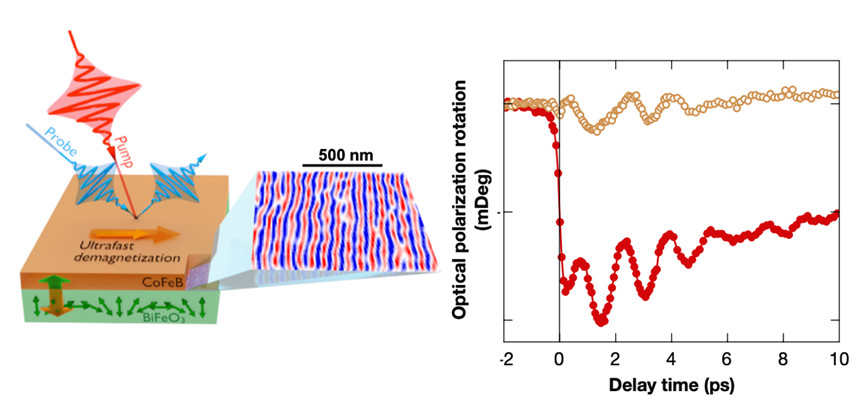
Left: Schematic of the setup used for time-resolved magneto-optical Kerr effect (Tr-MOKE) measurements on BiFeO₃ (shown in green, exhibiting an AF cycloidal state) topped by a CoFeB layer, and an NV-centers magnetometry image of the BiFeO₃ layer (with a cycloid period of 67 nm). The large, two-colored double arrow perpendicular to the plane symbolizes the ultrarapid angular momentum exchanges between the ferromagnetic CoFeB and antiferromagnetic BiFeO₃ layers.
Right: Ultrafast magneto-optical response of the CoFeB/BiFeO₃ bilayer when subjected to an intense femtosecond laser pulse (with CoFeB magnetization perpendicular (orange) or parallel (dark red) to the cycloid lines (blue-red) of BiFeO₃).
Beyond this experimental demonstration, the study provides compelling evidence that insulating antiferromagnets can be efficiently driven by ultrafast spin currents. It therefore marks an important step towards terahertz spintronics, where magnetic information could be transported and processed at frequencies far beyond those accessible with today’s spintronic devices. More broadly, these findings open new avenues for investigating ultrafast spin-current propagation and spin transport in antiferromagnetic materials.
This work received support from the PEPR SPIN programme through the TOAST and ALTEROSPIN projects.
Reference
Terahertz antiferromagnetic dynamics induced by ultrafast spin currents
Sanjay René, Artem Levchuk, Amr Abdelsamie, Zixin Li, Pauline Dufour, Arthur Chaudron, Florian Godel, Pascale Gemeiner, Brahim Dkhil, Jean-Baptiste Moussy, Karim Bouzehouane, Stéphane Fusil, Vincent Garcia, Michel Viret, and Jean-Yves Chauleau. Science Advances 11 (2025) eadx1107 – HAL archives ouvertes
Collaboration
- Service de physique de l’État Condensé – SPEC – UMR 3680 CEA-CNRS
- Laboratoire Albert Fert, UMR CNRS – Thales
- Laboratoire Structures, Propriétés et Modélisation des solides (SPMS), CNRS – CentraleSupélec
Contact
- Jean-Yves Chauleau, Researcher at Laboratoire Nano-Magnétisme et Oxydes – LNO at SPEC.