

Researchers from the Laboratoire des Solides Irradiés – LSI (CEA / CNRS / École Polytechnique), in collaboration with Young teams from the Institut de Physique – JEIP (Collège de France / CNRS), Laboratoire de Physique des Interfaces et des Couches Minces – LPICM (CNRS / École polytechnique), Albert Fert Laboratory – LAF (CNRS / Thales) and Helmholtz-Zentrum Dresden-Rossendorf – HZDR have achieved the first all-optical realization of a photonic time crystal operating at terahertz frequencies. By using a plasmonic metamaterial whose optical properties are periodically and coherently modulated by an electromagnetic field, they experimentally observe the transition of the metamaterial into the photonic time crystal regime. This work opens new opportunities for the temporal control of light-matter interactions and plasmonic losses.
Spatial photonic crystals control the propagation of light through a periodic arrangement of materials in space. Their temporal counterpart, photonic time crystals, relies on a fundamentally different principle: instead of structuring space, the optical properties of the material are periodically modulated in time at a rate comparable to the oscillation period of the optical field. Theoretical studies over the past few years have predicted that such systems could give rise to novel phenomena, including parametric amplification of light and new ways of tailoring light–matter interactions. However, achieving an all-optical photonic time crystal has remained a major experimental challenge, requiring optical properties to be modulated with both large amplitude and high coherence on timescales shorter than a single optical cycle.
To overcome this challenge, the researchers designed and investigated a plasmonic metamaterial composed of InSb-based plasmonic cavities, where InSb is a narrow-bandgap semiconductor, driven by a periodic terahertz field. Under this excitation, the effective mass of the charge carriers varies dynamically as a result of the non-parabolic conduction band. These variations modulate the kinetic inductance of the plasmonic cavities, leading to a periodic modulation of their resonance frequency. Time-resolved pump-probe spectroscopy reveals that this modulation is coherent, occurs on a sub-optical-cycle timescale, and reaches a particularly large amplitude, corresponding to effective-mass variations of up to 80% of the carriers’ equilibrium effective mass. The experimental observations are reproduced with very good accuracy by a theoretical model based on Floquet theory, establishing a direct link between the spectroscopic signatures and the microscopic parameters governing the system.
Spectroscopic analysis then reveals the transition of the system into the photonic time crystal regime. The researchers show that this transition is associated with an exceptional point, where two optical modes driven by the periodic modulation coalesce before evolving differently. This interpretation, based on Floquet theory, is directly supported by the experimental measurements. In this new dynamical regime, parametric gain emerges, resulting in a narrowing of the linewidth of one of the modes. The measurements reveal a reduction of more than 50% in plasmonic losses in the system. To the best of the authors’ knowledge, this is the first experimental demonstration of plasmonic loss reduction induced by temporal parametric modulation.
Credits: B. Schröder/HZDR
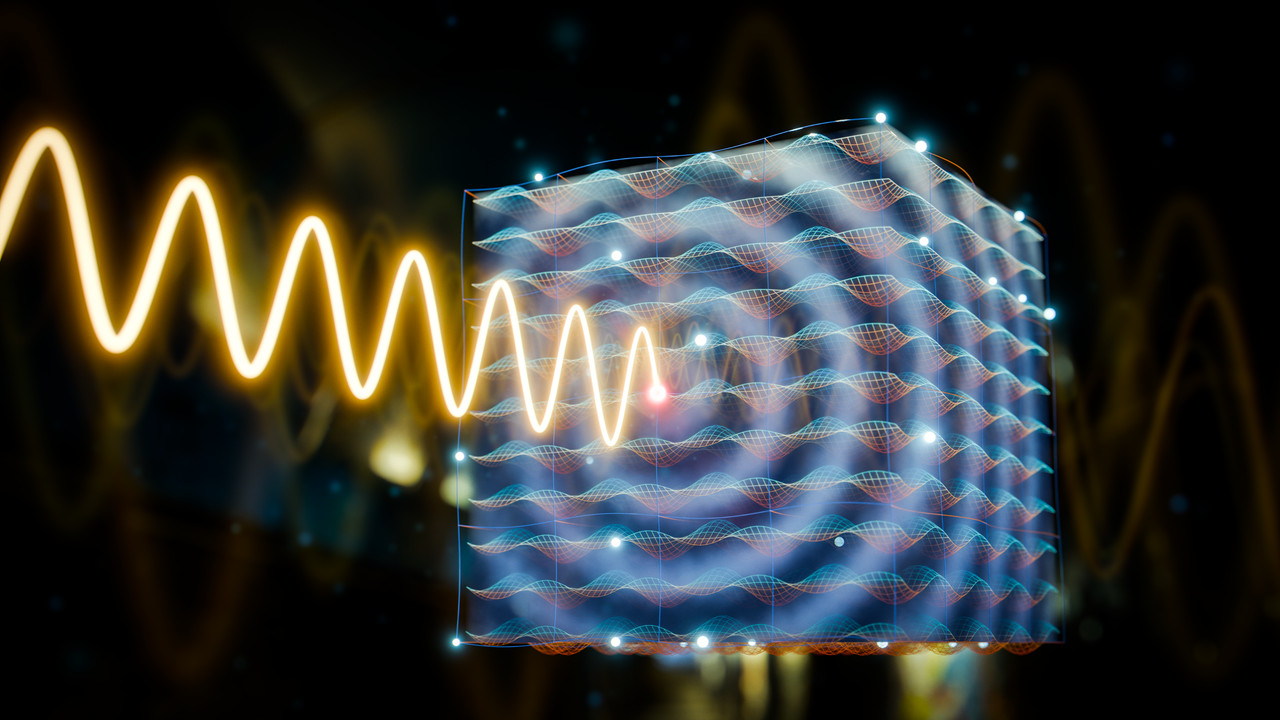
An electromagnetic wave in the terahertz (THz) range induces rapid, high-amplitude temporal modulations of the optical properties of the material (InSb) at the wavelength scale. This results in a “photonic crystal,” whose lattice evolves over time at the frequency of the (THz) wave, forming a “temporal photonic crystal.”
Beyond this demonstration, the study establishes a new experimental platform for investigating all-optical photonic time crystals. It shows that ultrafast modulation of the carriers’ effective mass can be harnessed to dynamically control the optical properties of plasmonic metamaterials, opening new prospects for the temporal engineering of dissipation and light-matter interactions in plasmonic systems. The authors further indicate that optimizing the cavity geometry and the driving conditions could, according to their theoretical model, enable operation in the plasmonic lasing regime, although this remains a theoretical prediction at this stage.
Reference
- Plasmonic metamaterial time crystal
Tingwen Guo, Jules Sueiro, Gian Marcello Andolina, Artem Levchuk, Stefano Ponzoni, Romain Grasset, Donald Monthe, Ian Aupiais, Dmitri Daineka, Javier Briatico, Thales VAG de Oliveira, Alexey Ponomaryov, Atiqa Arshad, Arjun Karimbana-Kandy, Gulloo Lal Prajapati, Igor Ilyakov, Jan-Christoph Deinert, Sebastian F. Maehrlein, Luca Perfetti, Marco Schiro, Yannis Laplace, Nature 656 (2026) 343–348 - See the CNRS-Physique – École Polytechnique highlight: “Premier cristal photonique temporel entièrement optique“.
- See the École polytechnique, CNRS and Helmholtz-Zentrum Dresden-Rossendorf (HZDR) press release.
Collaboration
- Young teams from the Institut de Physique, JEIP (CNRS / Collège de France)
- Laboratoire de Physique des Interfaces et des Couches Minces, LPICM (CNRS / École polytechnique / Institut Polytechnique)
- Laboratoire Albert Fert, LAF (CNRS / Thales)
- Helmholtz-Zentrum Dresden-Rossendorf, HZDR
Contact
- Yannis Laplace (LSI/NEE) & Romain Grasset (LSI/DDSM), research scientists at LSI.