

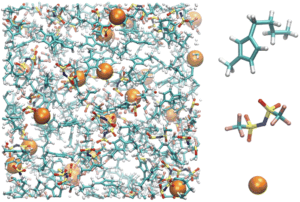
Researchers from the Laboratoire Léon Brillouin – LLB, in collaboration with the Laboratoire de Physique des Solides – LPS, the Laboratoire Électrochimie et Physicochimie des Matériaux et des Interfaces – LEPMI, the Laboratoire Interdisciplinaire de Physique – LiPhy and the Institut Laue-Langevin – ILL, have uncovered the molecular mechanisms governing transport properties in ionic liquid electrolytes. By combining experiments with molecular simulations, they reveal how the nanoscale organization of ions directly controls ion mobility and, ultimately, the performance of these systems.
Ionic liquids, which are composed entirely of ions, exhibit remarkable properties including negligible volatility, high thermal stability and a wide electrochemical window. These characteristics make them promising electrolytes for lithium and post-lithium batteries. However, their performance depends critically on ion transport, a phenomenon that remains poorly understood because of the complexity of their internal organization.
By combining X-ray scattering, NMR spectroscopy and molecular simulations, the researchers show that these liquids are far from homogeneous. Instead, they display a nanostructured organization with pronounced local heterogeneities. At this scale, ion-rich domains coexist with more mobile regions, forming a dynamic mosaic in which transport properties vary significantly across different length and timescales.
The study demonstrates that ion mobility strongly depends on the local environment. Some ions remain tightly bound within coordination shells or aggregates, which slows down their diffusion, while others move much more freely. This coexistence of distinct dynamical behaviours accounts for the broad distribution of diffusion rates observed experimentally.
Using an innovative single-particle tracking approach, the researchers establish a direct link between local structure and ion dynamics over timescales ranging from picoseconds to hundreds of nanoseconds. These findings challenge conventional average descriptions and demonstrate that ion transport in these electrolytes is intrinsically heterogeneous and multiscale.
This detailed understanding opens new opportunities for designing electrolytes better suited to next-generation batteries by tailoring nanoscale structuring and ionic interactions to optimize ion transport.
Reference
Structural and dynamical heterogeneities at the nanoscale in alkali/earth alkaline ionic liquid electrolytes: experiment and molecular simulation.
Patrick Judeinstein, Hoang Phuong Khanh Ngo, Fabrice Cousin, Cristina Iojoiu, Emilie Planes, Benoît Coasne, Phys. Chem. Chem. Phys. (2026), 28: 3850-3865 – hal-05507471v1
Collaboration
- Laboratoire de Physique des Solides – LPS
- Laboratoire Électrochimie et Physicochimie des Matériaux et des Interfaces – LEPMI
- Laboratoire Interdisciplinaire de Physique – LiPhy
- Institut Laue-Langevin – ILL