

Researchers from CIMAP (CEA-CNRS-ENSICAEN-University of Caen Normandy), in collaboration with GREYC (CNRS-ENSICAEN-University of Caen Normandy), show that ion irradiation can spontaneously structure SrTiO₃ surfaces into regular nanoscale patterns, and investigate the associated structural changes.
Shaping surfaces at very small scales (tens of nanometers) is important for future electronic and optical technologies. One way to do this is by bombarding a surface with ions-charged particles. Under certain conditions, this does not simply damage the surface randomly: it can instead create regular patterns, similar to tiny waves. While this effect is well known in some materials, it has been less explored in complex oxides such as SrTiO₃.
In this study, the authors irradiate SrTiO₃ with low-energy argon ions. They observe the formation of regular ripple-like patterns across the surface. The distance between ripples is about 140–150 nanometers (around a thousand times smaller than a human hair) and remains nearly constant as irradiation continues. However, the ripple height increases from fractions of a nanometer to a few nanometers, meaning the surface becomes progressively more corrugated.
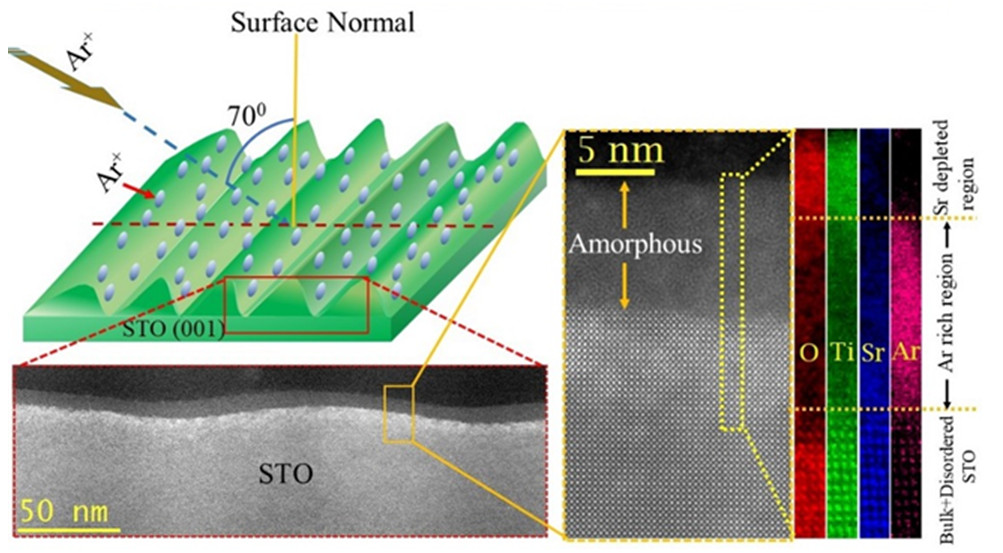
Irradiation geometry schematic – STEM image of the irradiated sample (surface ripples visible) – EELS chemical maps
The irradiation also affects the material just beneath the surface. Over a thickness of about 10 nanometers, the atomic structure becomes disordered (amorphous). In addition, some elements such as strontium and oxygen are partially depleted, while argon atoms become trapped below the surface. These effects remain confined to this thin near-surface region.
When the material is heated, most of the crystal structure is restored: atoms reorganize into their original arrangement. However, the ripple pattern remains essentially unchanged. This means that the surface shape is stable, even though the internal structure recovers.
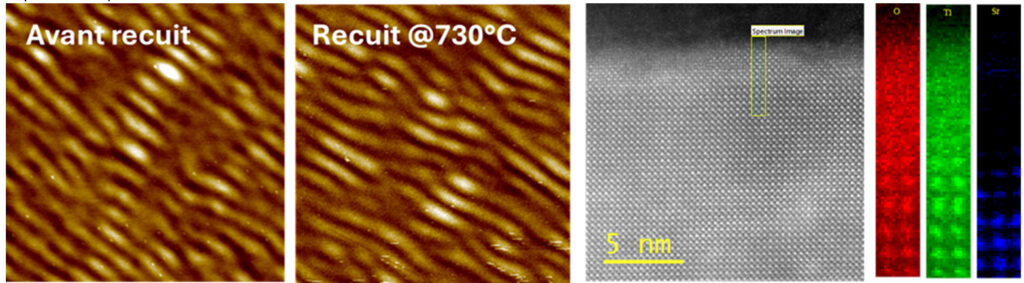
AFM images of the irradiated sample before and after annealing at 730 °C (ripples preserved after annealing) – EELS chemical maps of the annealed sample (Sr-depleted top surface layer)
This work demonstrates a simple way to create regular nanoscale patterns on oxide surfaces without complex fabrication techniques. Such structured surfaces could be used as templates for growing other materials or tuning physical properties. At the same time, the study highlights that this process also induces local material changes that need to be considered.
Reference
Nanoscale ripples at the surface of SrTiO3 irradiated by a broad low‐energy Ar+ (7 keV) ion beam.
Mohammad S. Jamal; Isabelle Monnet; Jimmy Rangama; Victor Pierron; Bruno Guillet; Stéphane Guillous; Stéphane Flament; Emmanuel Balanzat; Laurence Méchin; Mamour Sall, Small (2026): e11071.
See the previous highlights :
- Microstructuring of surfaces by high-fluence grazing-incidence ion beam irradiation (2023)
- Surface structuration by swift heavy ion irradiation (2017)
Collaboration
Contact CEA
- Mamour Sall, Centre de recherche sur les Ions, les Matériaux et la Photonique – CIMAP/Madir.