

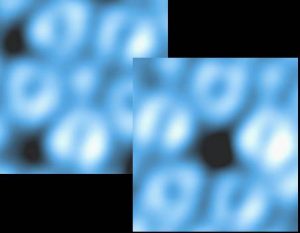
Identification of the atomic structure of the fivefold surface of an icosahedral Al-Pd-Mn quasicrystal, L.Barbier, D. Le Floc’h, L. Piccolo, Y. Calvayrac et D. Gratias Phys.Rev.Lett 88 (2002) 085506.
The Structure of Quasicrystals
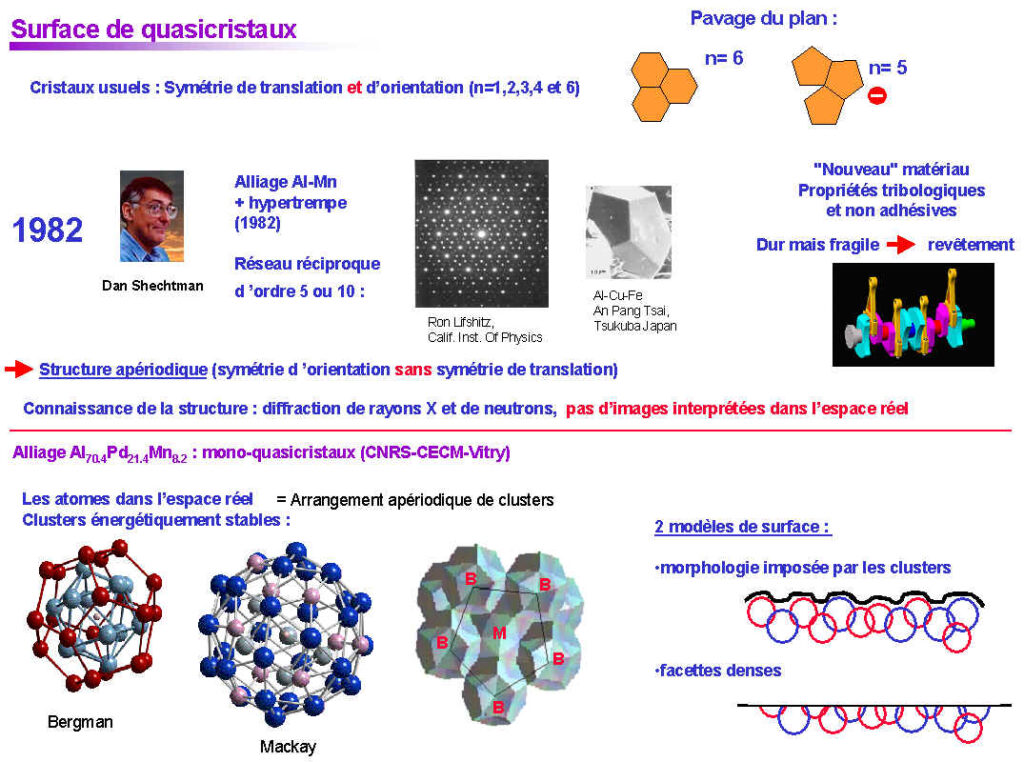
The quasicrystalline state can be found in alloys (such as Al-Pd-Mn) within narrow concentration ranges. Volume diffraction spectra (X-rays, neutrons) indicate a structure with orientation symmetries of order 5 or 10 that are forbidden by conventional crystallography, as they are incompatible with any translational symmetry. A symmetry of order 5 is, however, permitted if the solid in question is aperiodic. Diffraction data have provided a precise picture of the structure of quasicrystals. They form the basis of the theoretical models developed by D. Gratias (ONERA) and A. Katz (École Polytechnique), from which local atomic configurations can be derived. The models show that quasicrystals are composed of elementary motifs (Bergman- and Mackay-type intermetallic aggregates, known for their stability) that are distributed aperiodically. However, until now, no actual image at the atomic scale had been successfully interpreted.
The surface structure of quasicrystals
Regarding the surface of quasicrystals, two competing trends exist: the surface may preserve the aggregate structure to minimize volume energy (as suggested by cleavage experiments) or exhibit flat terraces (minimizing surface area).
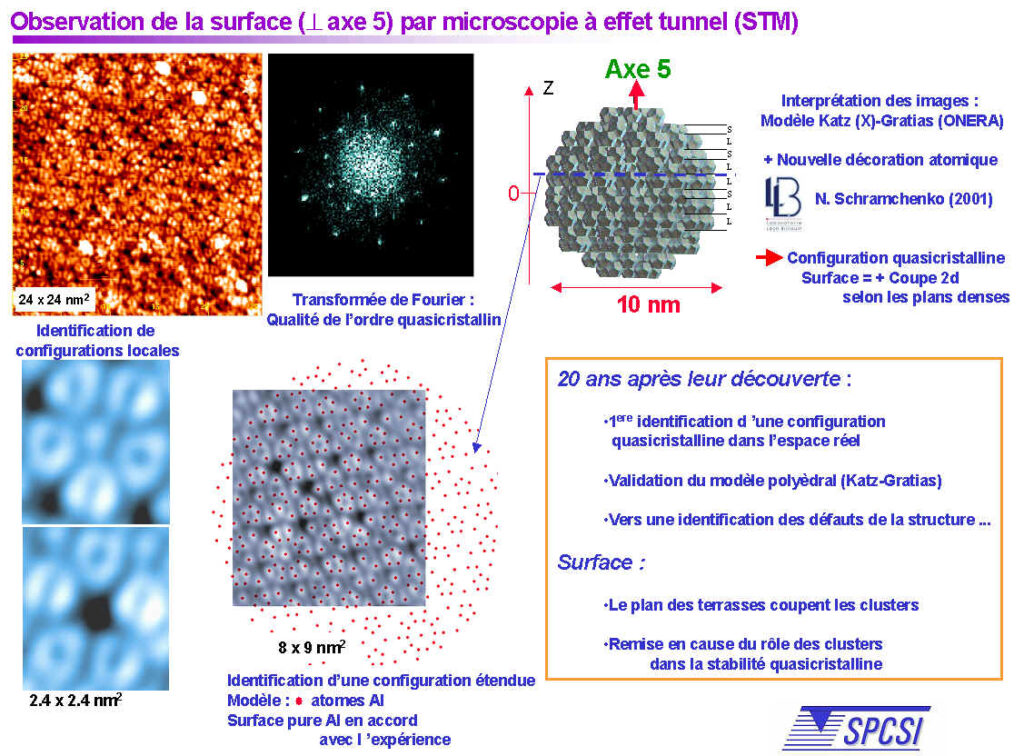
The alloy studied, Al70.4Pd21.4Mn8.2, exhibits icosahedral symmetry (6 axes of order 5). The single quasicrystal, prepared by Y. Calvayrac (CECM-CNRS, Vitry), features pentagonal growth facets oriented along one of these axes. Helium diffraction and scanning tunneling microscopy (STM) on these facets reveal a surface with large flat terraces. Images with atomic resolution were obtained. As shown by the Fourier transform of the image, the quasicrystalline order is of high quality.
The observed patterns were interpreted using the Katz-Gratias model, which was recently revised to account for neutron scattering experiments at the LLB. The 5-petal flower-like patterns appearing in the images are too small to be uniquely identified. By considering a 10×10 nm² pattern, a unique match with the model’s configurations was obtained, thereby validating the model.
In agreement with Auger spectroscopy analysis, it is shown that the terraces correspond to dense pure-Al planes that cut through the aggregates, whose energetic stability is therefore not the key factor in the surface’s stability.
This first real-space identification of the structure of quasicrystals at the atomic scale paves the way for the study of structural defects, which is essential for understanding what remains a mystery today: the growth of quasicrystals.
Reference:

Identification of the atomic structure of the fivefold surface of an icosahedral Al-Pd-Mn quasicrystal
Luc Barbier, David Le Floc’h, Laurent Piccolo, (DSM/DRECAM/SPCSI), Yvonne Calvayrac (CNRS-CECM) et Denis Gratias, Phys.Rev.Lett 88 (2002) 085506.
CEA contact: Luc Barbier (DRECAM/SPCSI).
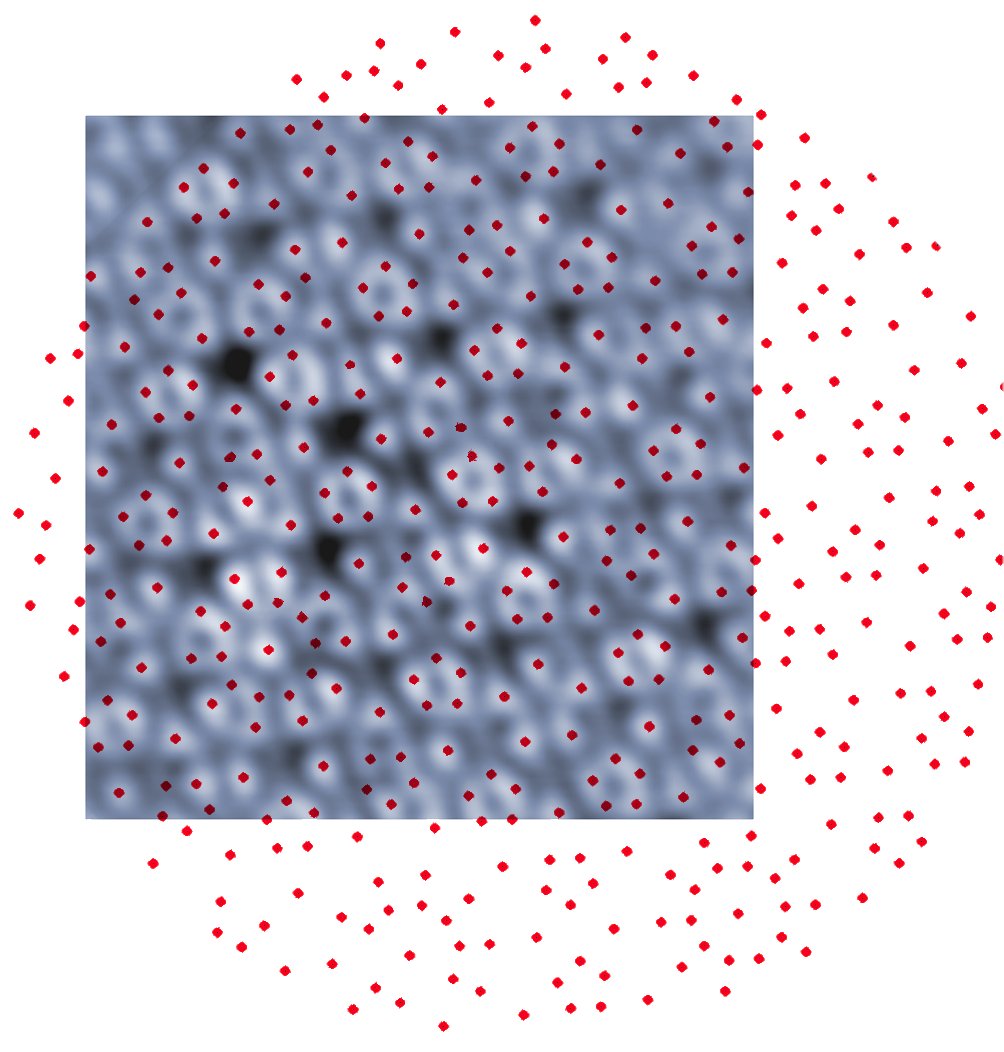
Perfect agreement between the STM image (aluminum atom terrace) and the simulation of the configuration based on the Katz-Gratias model