
Abstract:
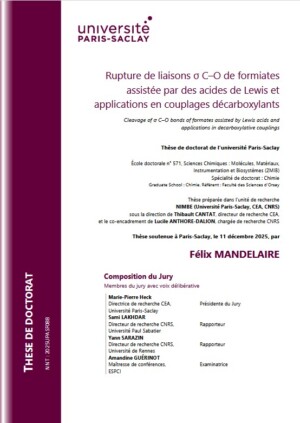
To utilize biomass as a carbon source, it is crucial to develop efficient and economical methods for breaking C–O bonds. Formic acid can act as a potential reducing agent. In this thesis, the use of formate, formed from alcohol and formic acid as bifunctional reagents, is considered.
Indeed, on either side of the CO2 motif, there are two different reactivities, an electrophilic part and a nucleophilic part. Nevertheless, the activation of a C–O bond and a C–H bond is necessary to enable reactivity. In order to activate the electrophilic part of the formate, the cleavage of the σ C–O bond by halogenated Lewis acid salts such as LiI, CaI₂, MgI₂, or AlI₃ was studied. Kinetic studies were conducted, and we observed the effect of Lewis acidity on reactivity: the stronger the Lewis acid, the less energy the reaction requires. The use of these Lewis acids in tandem catalysis with metal complexes then led to the development of two reactions :
- The first reaction is the deoxygenation of alcohol by formic acid, which is catalyzed by the Ru(triphos)(OAc)2 complex.
- The second is a Heck-type reaction that allows access to substituted alkenes and is catalyzed by the Co(TPP) complex.
Finally, preliminary results have been obtained for the transfer hydroalkylation reaction on alkenes. This reaction formally allows the addition of a hydrogen atom and an alkyl group on either side of a double bond.
Keywords: Formate, C–O bond, Lewis acid, Catalysis, Decarboxylation