

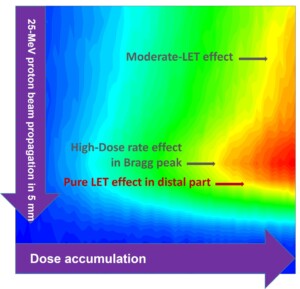
Researchers from the DICO group at LIDYL, in collaboration with several partner institutions, have measured the local production of radical species in water with unprecedented spatial resolution along the trajectory of a proton beam. This study provides new insight into the physico-chemical processes occurring in the terminal region of proton beams, where energy deposition reaches its maximum, known as the Bragg peak.
Understanding the chemistry of water radiolysis in this region is a key scientific challenge. As protons travel through water, they deposit energy and trigger a cascade of ultrafast reactions that generate highly reactive species, notably the hydrated electron and the hydroxyl radical. These species play a central role in radiation-induced biological damage, for example in proton therapy. Yet measuring their production precisely near the Bragg peak is difficult: the region where protons stop is extremely narrow (typically 1-2 mm) and the physico-chemical conditions evolve rapidly along the track. To overcome this limitation, the researchers implemented an original optical spectrometer based on a bundle of optical fibers, enabling spatially resolved measurements with a resolution of about 280 µm and real-time monitoring of radiolysis products in the final millimeters of a 62 MeV proton beam in liquid water.
The measurements reveal a clear evolution of radical yields along the proton track. In the initial regions of the trajectory, the yields decrease gradually as the deposited energy increases. They reach a minimum near the Bragg peak, where the dose rate is maximal. For instance, the hydroxyl radical yield measured through absorption techniques drops to about 2.2 × 10⁻⁷ mol J⁻¹ in this region. Surprisingly, the yields then partially recover in the region located just beyond the Bragg peak, the so-called distal region. This trend, consistently observed with several experimental detection methods, indicates that the chemical processes occurring at the end of proton tracks differ from those occurring earlier along the beam path.
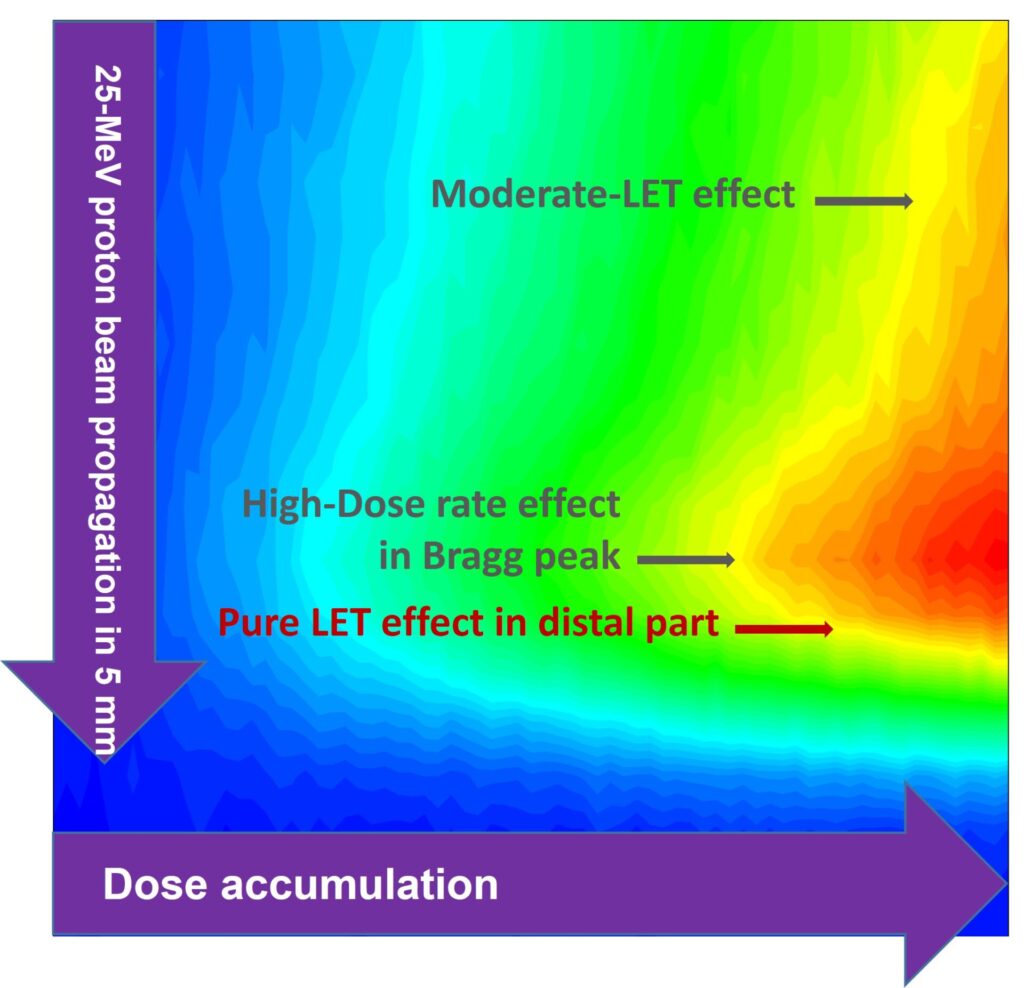
One possible explanation lies in the evolution of the microscopic structure of ionization tracks produced by the protons. As the particles slow down, the distribution of their energies and the density of ionization events change, altering the environment in which radicals are produced and interact. The energy dispersion of protons close to their stopping point may therefore modify the local structure of ionization tracks and contribute to the observed increase in radical yields beyond the Bragg peak, although the exact origin of this behaviour remains difficult to establish.
More broadly, the study highlights the experimental challenges involved in directly measuring radical species under high-ionization-density conditions. Optical probe molecules used to detect radicals can themselves be altered within ionization tracks or experience fluorescence quenching, leading to an underestimation of absolute yields. Despite these limitations, the results provide valuable new insight into the radiation chemistry of proton beams in water and help clarify the physico-chemical mechanisms occurring in the Bragg peak region ; an area of particular importance for radiobiology and for optimizing proton-therapy treatments.
Reference
“Hydrated electron and hydroxyl radical end-of-track yields under proton beam in water”, J. Audouin, L. Desorgher, P. Hofverberg, G. Baldacchino, Radiation Physics and Chemistry (2025).
Collaboration
- Vaud University Hospital (CHUV), Lausanne University Hospital.
- Antoine Lacassagne Cancer Centre – UNICANCER/CAL in Nice.
- Claude Lalanne Research Federation.
Contact
Gérard Baldacchino, Research Director, Dynamics and Interactions in the Condensed Phase group – DICO, Interactions, Dynamics and Lasers Laboratory – LIDYL, CEA-IRAMIS.