
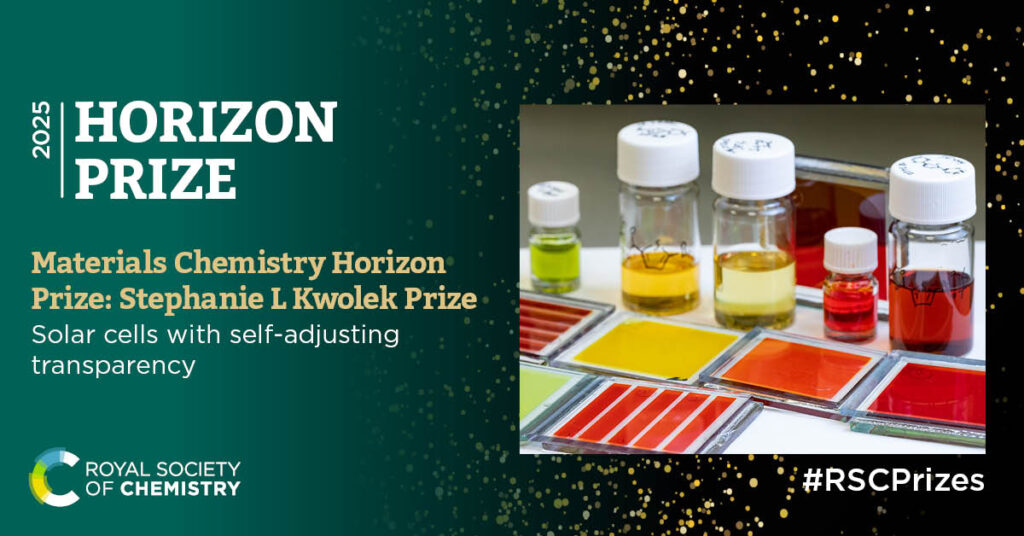
The PISCO team has been awarded the 2025 Materials Chemistry Horizon Prize: Stephanie L. Kwolek Prize, presented by the Royal Society of Chemistry. Among the co-recipients is Frédéric Oswald, Research Director and Head of the LICSEN group at NIMBE (CEA-CNRS joint research unit), in recognition of his contribution to this five-year collaborative scientific effort.
The prize recognises significant recent discoveries or advances in the field of materials chemistry. The PISCO team, led by Renaud Demadrille (CEA-IRIG), was honoured for the development of new photochromic dyes for use in semi-transparent solar cells with light transmittance that adapts to illumination conditions.
Innovative Dyes for Adaptive Solar Cells
The awarded research focuses on dye-sensitized solar cells (DSSCs) incorporating photochromic molecules capable of modulating their colour and therefore their transparency depending on light intensity.
These molecules remain transparent under low-light conditions and darken automatically under strong sunlight. When integrated into photovoltaic devices, they enable simultaneous electricity generation and adaptive light management. Achieving this balance between transparency and photovoltaic efficiency is crucial for applications such as building façades, smart windows, and certain agricultural installations.
In the context of the energy transition and the urgent need for sustainable solutions, these advances contribute to rethinking how photovoltaics can be integrated into the built environment, combining performance, functionality and adaptability.
A European Collaborative Dynamic
This international recognition reflects a long-standing scientific collaboration between CEA-IRAMIS and CEA-IRIG, alongside academic and industrial partners in France, Spain and Switzerland.
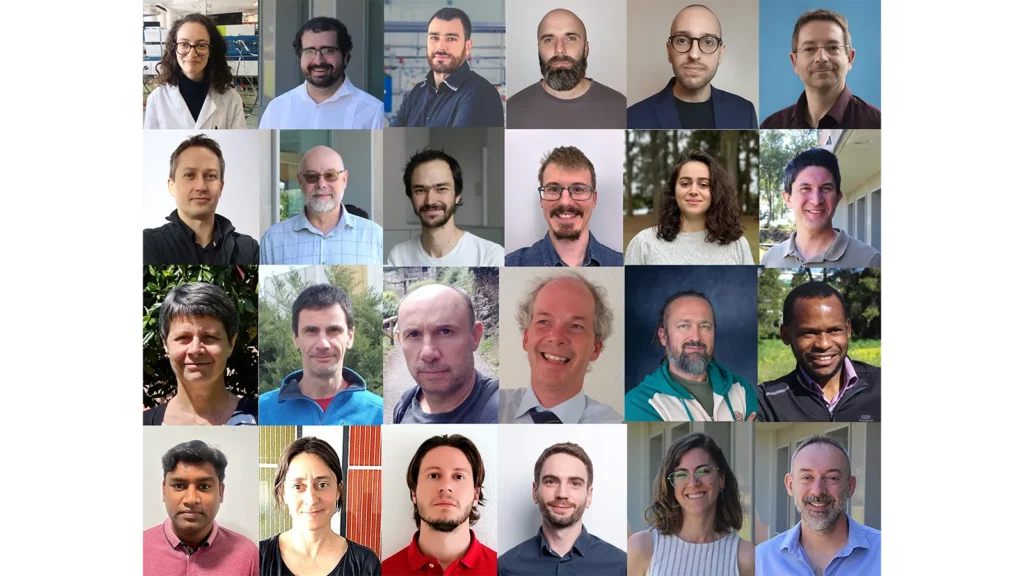
Renaud Demadrille, project lead, comments:
What truly inspires and motivates us is the opportunity to explore a new subject and help push the boundaries of knowledge in our field. As we shared the challenges we were facing, it was clear how engaged the team was, eagerly proposing new molecular designs, suggesting modifications to characterisation equipment, and applying machine learning approaches to accelerate device optimisation.
The 2025 Materials Chemistry Horizon Prize highlights the scientific excellence of the PISCO team and the commitment of its members at the interface of molecular chemistry, functional materials and innovative photovoltaic technologies.