

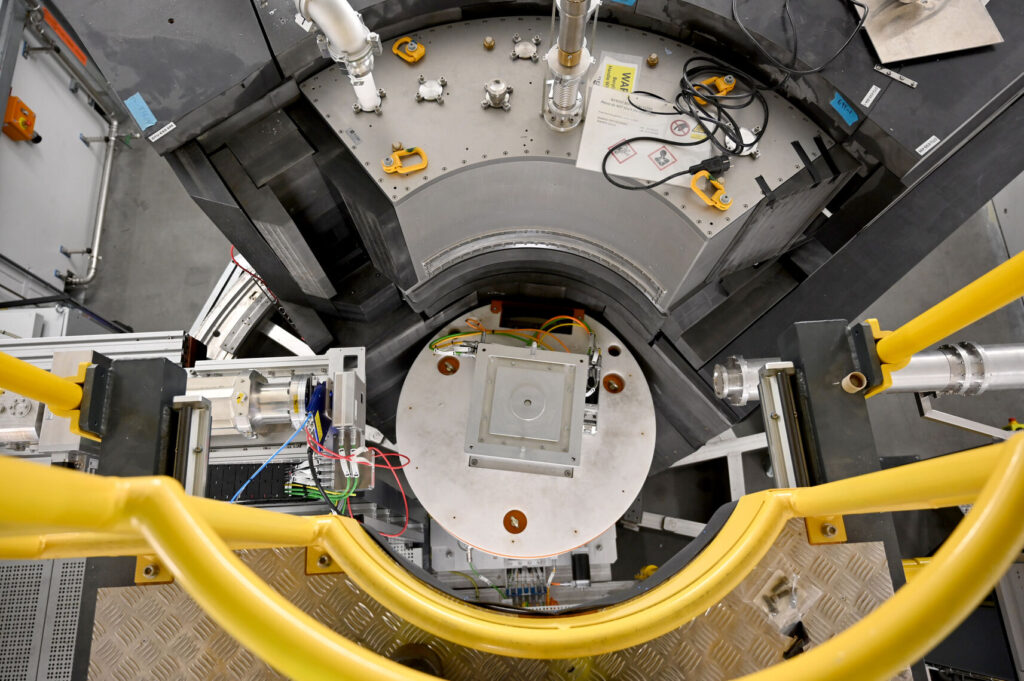
BIFROST, an inelastic neutron spectrometer at the European Spallation Source (ESS), is now waiting for its first neutrons. This milestone marks a major step forward for one of the first 15 scientific instruments being deployed at the European research facility.
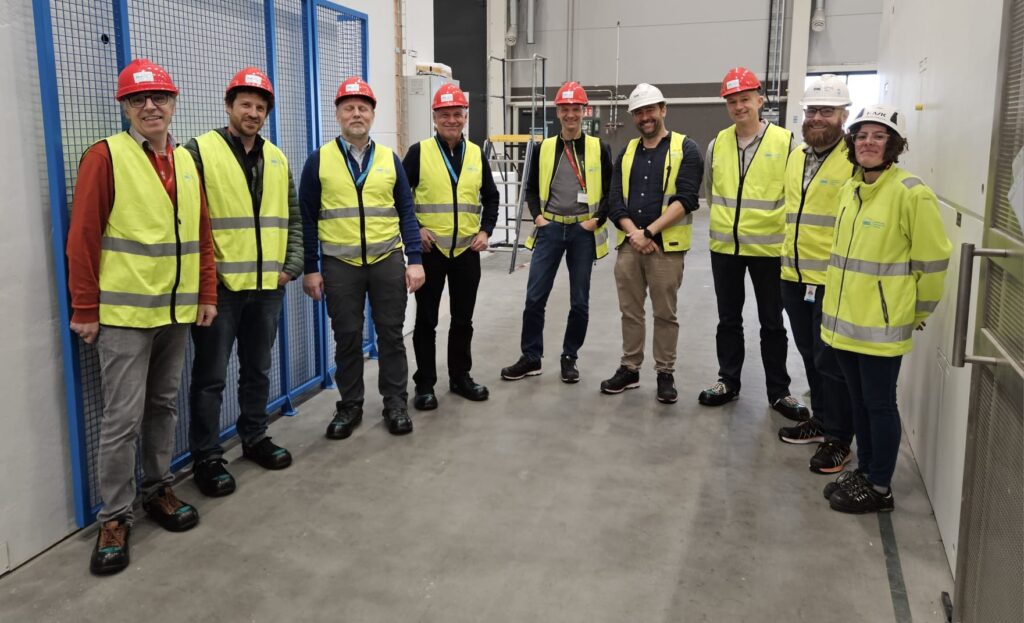
Built by a European consortium including the Technical University of Denmark (DTU), the University of Copenhagen, the Institute for Energy Technology (IFE), the Paul Scherrer Institute (PSI), ESS and the Laboratoire Léon Brillouin (LLB), BIFROST successfully passed its Instrument Safety Readiness Review (iSRR) in December 2025. After 14 years of development, from initial design to construction and installation, this step confirms that the instrument is now technically ready to receive neutrons.
Studying matter under extreme conditions
BIFROST measures how neutrons exchange energy and momentum with materials, a technique called inelastic neutron scattering. This allows scientists to see atomic and magnetic motions that are directly linked to material properties.
It can study very small samples (down to 2 × 2 × 2 mm) under extreme environments: very low temperatures, high pressure, or strong magnetic fields. This combination of high neutron flux and experimental capabilities makes BIFROST a unique tool for studying phenomena that are otherwise very difficult to observe.
A French contribution within a European collaboration
The Léon Brillouin Laboratory (UMR CEA–CNRS) contributed to BIFROST through its expertise in neutron instrumentation. LLB teams were involved in developing and optimising key components of the instrument alongside European partners.
The imminent arrival of the first neutrons marks the culmination of many years of collective work and the beginning of a new phase: that of the first scientific experiments.
Probing high-temperature superconductors and societal impact
BIFROST will help scientists understand high-temperature superconductors, materials that carry electricity without resistance thanks to still-mysterious magnetic interactions. Its unique ability to study tiny samples under high pressure and intense neutron flux is crucial for this research.
The results could have tangible benefits in everyday life: high-temperature superconductors are already used in MRI magnets and some power applications. In the future, they could enable lossless power grids, compact high-capacity cables, and ultra-efficient energy storage systems – technologies key to a more sustainable and efficient energy future.