

The development of scalable quantum processors requires qubits that combine long coherence times with efficient control and readout. Nuclear spins in solids are naturally well protected from environmental noise, making them promising candidates for long-lived quantum memories. The main challenge has been to manipulate and measure individual nuclear spins in a solid-state device.
Researchers from the Quantronics group (SPEC, CEA-IRAMIS), together with several French and international partners, have now demonstrated coherent control and single-shot readout of individual nuclear spin qubits in a crystal, with coherence times exceeding seconds. This establishes a new solid-state platform that couples robust nuclear spins to superconducting resonators.
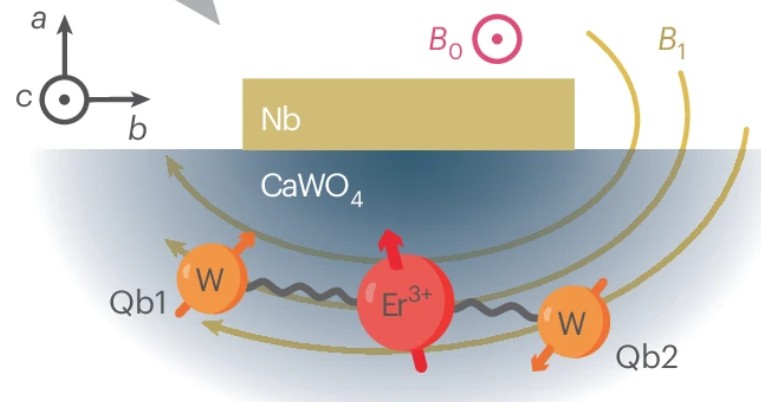
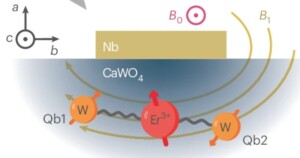
In most solid-state platforms explored so far, qubits are either fast to control but short-lived (such as electron or superconducting qubits), or long-lived but difficult to access (such as nuclear spins). Bridging this gap is essential to design scalable architectures. The present study tackles this challenge by using 183W nuclear spins in a CaWO₄ crystal, located next to erbium Er3+ ions. The electron spin of Er3+ acts as an intermediary (ancilla), linking the nuclear spins to a superconducting resonator patterned on the crystal surface. With the help of a highly sensitive microwave photon detector operating at 10 mK, the team could perform quantum non-demolition, single-shot readout of the nuclear spin state, a key step for any qubit platform.
Two individual nuclear spins were characterized. They displayed exceptionally long coherence times: dephasing times T₂* of 0.8 and 1.2 seconds, and Hahn echo coherence times T₂ of 3.4 and 4.4 seconds. These durations are significantly longer than those of most solid-state qubits, and comparable to the best values reported in specially engineered materials such as isotopically purified silicon or diamond.
To manipulate the qubits, the researchers developed an all-microwave control scheme based on stimulated Raman driving of the coupled electron-nuclear system. This allowed them to implement both single and two-qubit operations within a few milliseconds. With this control, they prepared an entangled Bell state of two nuclear spins with a fidelity of 0.79. Importantly, one such state was found to lie in a decoherence-free subspace, making it intrinsically more resilient to magnetic field noise, and extending its effective coherence time to 1.7 seconds.
This proof-of-concept shows that solid-state nuclear spins can serve as controllable, long-lived qubits, opening perspectives for their integration into larger registers or in hybrid architectures where they could be linked to superconducting qubits. The work involved close collaboration between academic partners, in France and internationally, underlining the multidisciplinary effort required to explore new quantum hardware. Beyond quantum information processing, the methods developed here may also find applications in quantum sensing and high-precision spectroscopy.
Reference
J. O’Sullivan, J. Travesedo, L. Pallegoix, Z.W. Huang, P. Hogan, A.S. May, B. Yavkin, S. Lin, R.-B. Liu, T. Chanelière, S. Bertaina, P. Goldner, D. Estève, D. Vion, P. Abgrall, P. Bertet, E. Flurin, Individual solid-state nuclear spin qubits with coherence exceeding seconds, Nature Physics, 2025.
Contact CEA-IRAMIS
James O’Sullivan – Quantronics Group, SPEC, CEA-IRAMIS, Université Paris-Saclay.