

The transport and targeted delivery of active pharmaceutical ingredients largely rely on the use of nano-vectors capable of circulating in the body without rapid clearance. One of the key challenges is to design “stealth” systems that limit protein adsorption and the formation of a protein corona, which strongly affects biological behavior. PEGylation is currently the most widely used strategy to address this issue.
In this context, researchers from the Laboratoire Léon Brillouin (CEA-IRAMIS), in collaboration with several French and European partners, have developed a simple and robust approach to design thermo-responsive PEGylated self-assemblies whose morphology can be tuned between tubes, vesicles, and micelles. Based on bio-sourced fatty acids and fine control of membrane curvature, this strategy opens new perspectives for the design of adaptive nano-vectors operating under physiological conditions.
In pharmacology, the transport and controlled delivery of active compounds generally rely on their encapsulation into submicrometric nano-vectors formed through the self-assembly of surfactants (lipids, fatty acids, etc.) and/or polymers. A fundamental challenge is to render these nano-vectors “stealthy” in order to prevent protein adsorption from physiological fluids. Without this property, a protein corona rapidly forms around the colloidal objects and governs their in vivo biological behavior. The most common strategy to achieve stealth properties consists in grafting a protective polymer corona made of polyethylene glycol (PEG) chains.
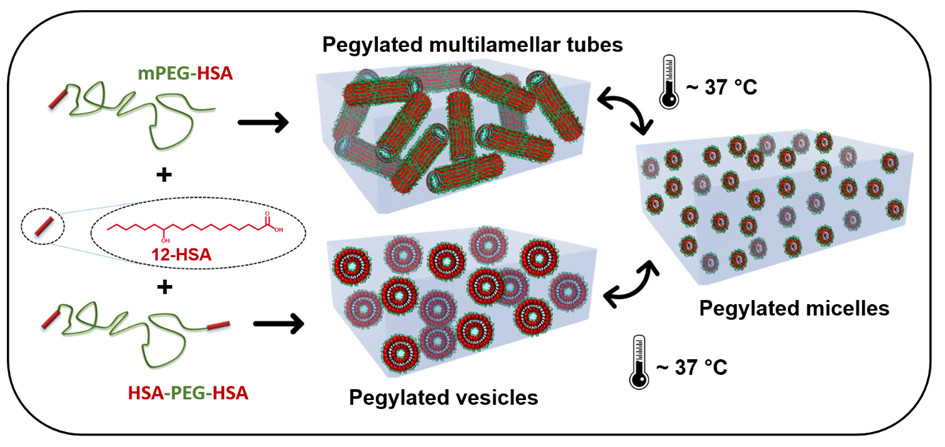
In a recent study, researchers from the Laboratoire Léon Brillouin, in collaboration with partners in France and across Europe, developed a simple and robust approach to design PEGylated self-assemblies displaying, at room temperature, two original morphologies: spherical vesicles or multilamellar tubes decorated with PEG chains. This was achieved by combining 12-hydroxystearic acid (12-HSA) molecules – a bio-sourced fatty acid surfactant known to spontaneously form tubes in aqueous solution – with PEG chains functionalized with 12-HSA moieties through a simple synthesis, either at one end or at both ends of the polymer chain.
Mono-functionalized PEG chains spontaneously insert into 12-HSA tubes, whereas the insertion of di-functionalized PEG chains induces a strong modification of membrane curvature, leading to vesicle formation. These assemblies also exhibit thermo-responsive behavior, reversibly transitioning into small ellipsoidal micelles with radii of a few nanometers. By carefully tuning the physicochemical conditions, the transition temperature can be adjusted to physiological temperature. This morphological transition directly controls the viscoelastic properties of the suspensions, which behave as soft gels at low temperature and as Newtonian liquids at higher temperature.
The detailed structural characterization of these assemblies was carried out using small-angle neutron scattering (SANS), a technique well suited for probing structures in suspensions over length scales ranging from approximately 0.5 nm to 200 nm. Combined with isotopic labeling strategies, SANS provides access to the specific structure of each component within complex mixed systems.
Reference
M. Almeida, D. Dudzinski, B. Couturaud, S. Prévost, V. Lutz-Bueno, N. Mahmoudi, C. Amiel, F. Cousin, C. Le Coeur, Design of thermo-responsive self-assembly of PEGylated fatty acids: Switching reversibly from tubes or vesicles to micelles at physiological temperature,
Journal of Colloid and Interface Science (Volume 693), 2025.
Collaboration
- Institut Chimie et des Matériaux Paris Est, Université Paris Est Créteil, CNRS, UMR 7182, 2 Rue Henri Dunant, 94320 Thiais, France.
- Institut Laue Langevin, 71 avenue des Martyrs, CS 20156, CEDEX 9, 38042 Grenoble, France.
- PSI Center for Neutron and Muon Sciences, 5232 Villigen PSI, Switzerland.
- ISIS Neutron and Muon Source, Rutherford Appleton Laboratory, Harwell Science and Innovation Campus, Chilton, Oxfordshire OX11 0QX, UK.
Contact CEA-IRAMIS
Fabrice Cousin – Laboratoire Léon Brillouin (LLB), CEA-IRAMIS.