


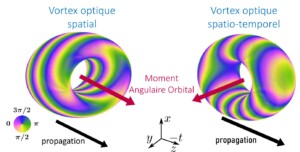
Spatiotemporal optical vortices (STOVs) constitute a new family of structured light fields in which the phase singularity extends through spacetime rather than across the transverse spatial plane.
Since their experimental demonstration in 2019, these objects have attracted growing interest in ultrafast optics because of their transverse orbital angular momentum, a property whose interpretation remains the subject of ongoing debate.
In a recent study, researchers at LIDYL propose a theoretical framework that sheds light on an apparently simple question: where exactly is the “center” of a structured light pulse, and how does the choice of this center define its orbital angular momentum?
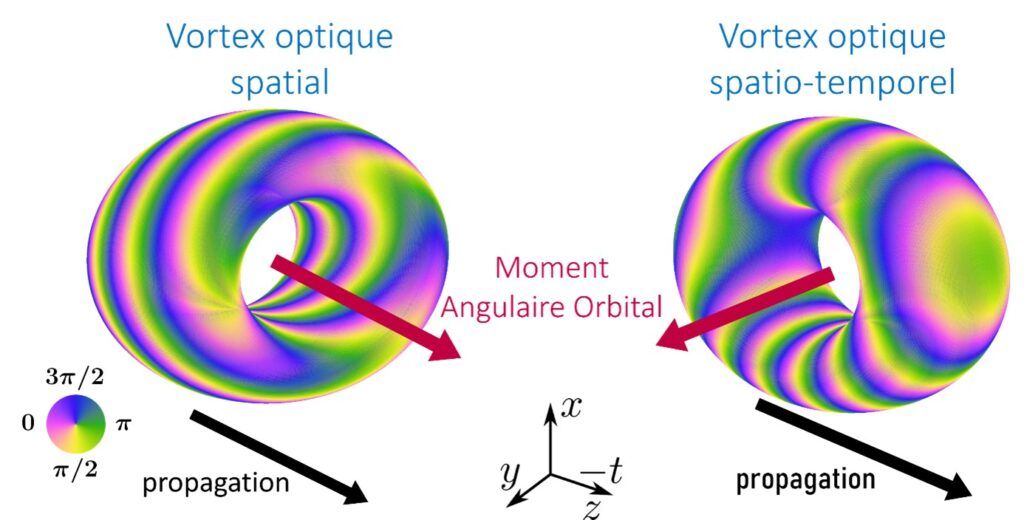
Phase distributions on an iso-intensity surface for a beam carrying longitudinal angular momentum (left), i.e., along the propagation axis, and for a beam carrying transverse angular momentum (right), perpendicular to the propagation axis. The former are conventional optical vortices, whereas the latter are known as spatiotemporal optical vortices.
For an ultrashort pulse, several definitions of the center coexist. One may define an energy centroid, associated with the distribution of electromagnetic energy, or a photon centroid, linked to the local distribution of photons. For an ordinary pulse, these two points generally coincide. However, in pulses exhibiting strong spatiotemporal couplings, such as spatiotemporal optical vortices, they can be distinct.
This difference is not merely a geometric detail. It directly affects the definition of the pulse’s intrinsic angular momentum. In a STOV, the presence of a phase singularity redistributes frequencies and distorts the field structure, leading to different shifts of the two centroids.
Furthermore, by providing a unified theoretical framework for both definitions, the study illustrates, through several examples, the possible differences in their trajectories during propagation. While the energy centroid moves along the average direction of the energy flow, the photon centroid remains sensitive to the pulse’s spectral distribution and may evolve differently.
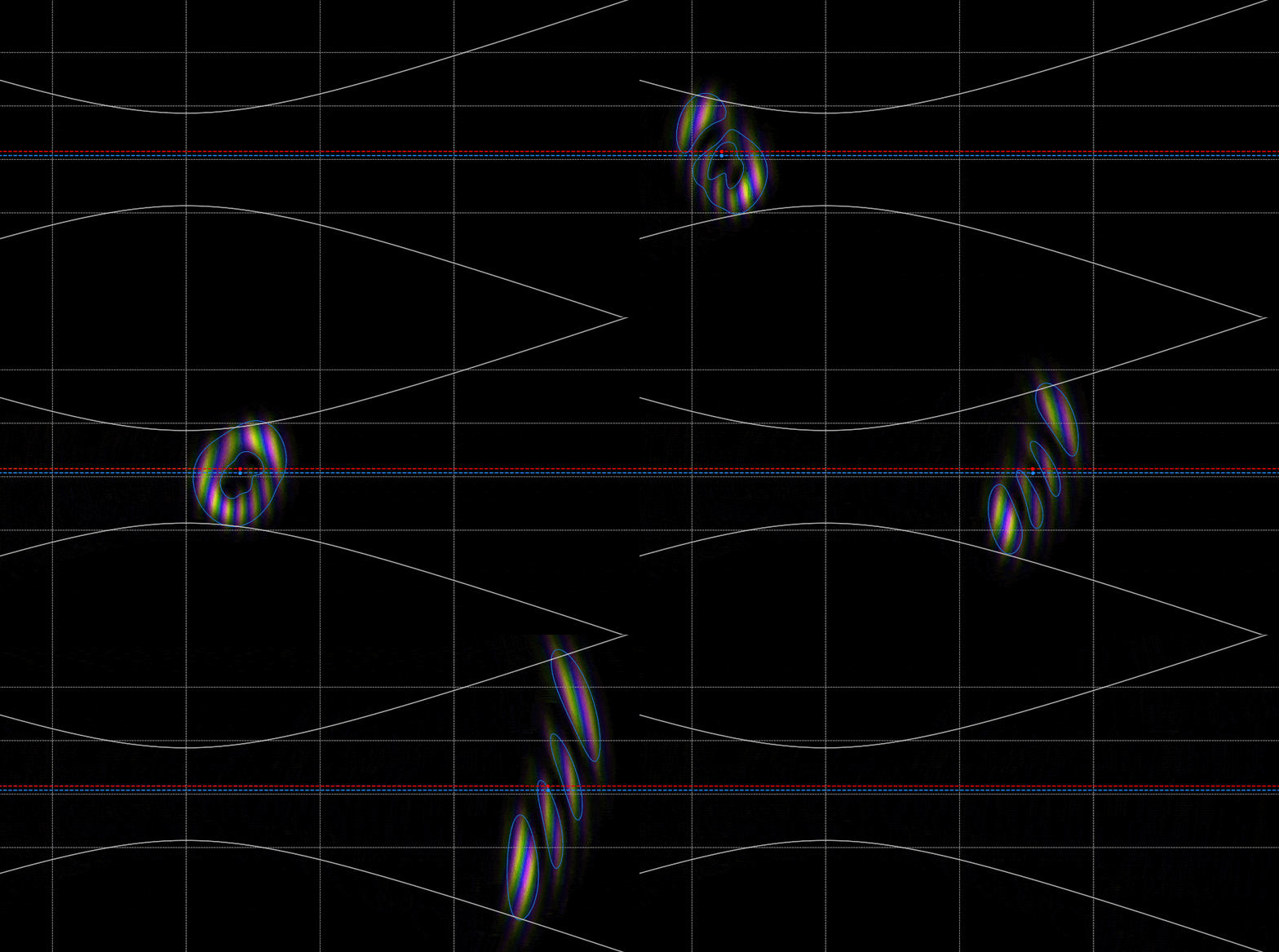
Simulation of the propagation of a spatiotemporal optical vortex. The red and blue lines represent the positions of the photon centroid and the energy centroid, respectively. They neither coincide with each other nor with the position of the phase singularity, but in this particular case follow parallel trajectories. The angular momentum calculated with respect to each of these centroids is transverse, but takes different values.
Beyond these geometric considerations, this work provides an important clarification regarding the quantum interpretation of STOVs. The commonly used notion of “angular momentum per photon” might suggest that each photon carries a well-defined amount of angular momentum, as is the case for conventional vortex beams. The authors show, however, that this is not so: unlike longitudinal orbital angular momentum, the transverse angular momentum of spatiotemporal optical vortices does not correspond to a quantized observable carried individually by photons.
By providing a rigorous description of the centroids and angular momentum of structured light pulses, this work helps clarify the physical foundations of spatiotemporal optical vortices. These results should facilitate the interpretation of future experiments involving complex ultrafast fields, particularly in nonlinear optics, harmonic generation, and quantum optics.
Contact : Thierry Ruchon, Titouan Gadeyne, Lidyl/atto.