



Researchers from the Laboratoire des Solides Irradiés – LSI, in collaboration with the Department of Physics of the Basel and Cagliari Universities, SATIE (CNRS, ENS Paris-Saclay, Université Paris-Saclay), and ICMAB-CSIC (Barcelona), have unraveled the mechanisms governing energy dissipation in germanium following ultrafast laser excitation. By combining time-resolved Raman spectroscopy, transient reflectivity measurements, and advanced numerical simulations, they reveal the successive stages of energy transfer between charge carriers, lattice vibrations, and locally generated strain. These findings provide new insight into the fundamental processes that govern the operation of semiconductor materials.
The performance of electronic, photonic, and quantum devices largely depends on how energy is redistributed within a material after optical excitation. When a semiconductor absorbs an ultrafast laser pulse, electrons and holes acquire excess energy that is rapidly transferred to the crystal lattice, whose collective atomic vibrations are known as phonons. These vibrations play a central role in heat transport and directly influence device performance. Although germanium has been studied for decades and is a key material for a broad range of applications, the mechanisms governing energy dissipation during the first few picoseconds after excitation have remained poorly understood. Previous studies lacked the temporal resolution required to fully resolve these ultrafast processes.
To overcome this limitation, the researchers combined two complementary ultrafast spectroscopy techniques. Time-resolved Raman spectroscopy directly probes the dynamics of optical phonons, while transient reflectivity measurements monitor the material’s electronic and mechanical response. The experimental observations were then interpreted using density functional theory (DFT) calculations and molecular dynamics simulations to identify the physical mechanisms underlying the measured dynamics. This combined experimental and theoretical approach makes it possible to directly connect the observed spectroscopic signatures with the microscopic energy transfer pathways occurring inside the material.
The measurements show that, following ultrafast laser excitation, photoexcited holes rapidly transfer their energy to optical phonons in germanium, whose temperature reaches a maximum after approximately four picoseconds. This energy is subsequently transferred to acoustic phonons through anharmonic coupling, with a characteristic decay time of 2.7 ± 0.2 ps, decreasing to 2.3 ± 0.1 ps at higher excitation fluence, in excellent agreement with the numerical simulations. The study also reveals a more unexpected result: the phonon temperature, Raman frequency, and Raman linewidth evolve on markedly different timescales. While the optical phonon temperature rapidly returns toward equilibrium, the Raman frequency and linewidth relax much more slowly. The simulations demonstrate that this behavior originates from local thermal strain generated by the ultrafast excitation. The experiments also reveal Brillouin oscillations, corresponding to the propagation of a strain pulse through the crystal, whose damping is correlated with the evolution of the Raman linewidth.
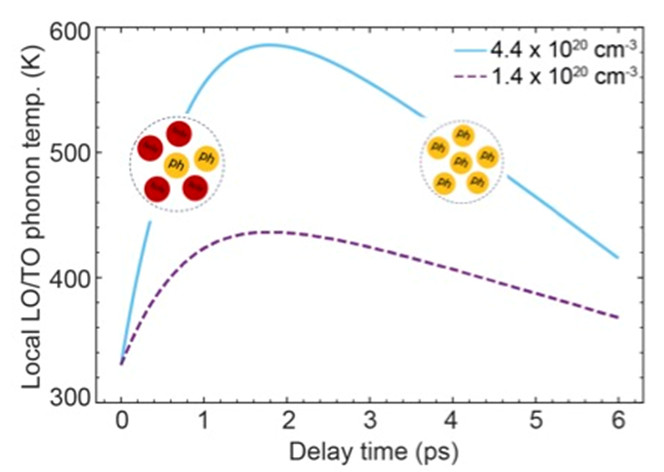
Calculated local increase of the Raman optical mode temperature due to the hole-phonon interaction, for hole densities of 1.4 × 10²⁰ cm⁻³ (purple dashed line) and 4.4 × 10²⁰ cm⁻³ (light blue solid line).
Beyond the specific case of germanium, these results disentangle the different energy dissipation pathways operating in semiconductors and the characteristic timescales associated with each of them. They demonstrate that the evolution of vibrational properties is governed not only by temperature but also by transient strain generated during ultrafast excitation. This improved understanding of the interplay between charge carriers, phonons, and lattice strain represents an important advance in semiconductor physics. More broadly, it provides fundamental knowledge for understanding the behavior of materials used in future microelectronic, photonic, and quantum devices, whose performance ultimately depends on mastering these ultrafast energy transfer mechanisms.
Reference
Unraveling energy flow mechanisms in semiconductors by ultrafast spectroscopy: germanium as a case study
Grazia Raciti, Begoña Abad, Riccardo Dettori, Raja Sen, Aswathi K. Sivan, Jose M. Sojo-Gordillo, Nathalie Vast, Riccardo Rurali, Claudio Melis, Jelena Sjakste, Ilaria Zardo, Advanced Science 13 (11) (2026) e15470 – hal-05385699v1.
Collaboration
- Department of Physics, Bâle university
- Department of Physics, Université de Cagliari
- Laboratoire des systèmes et applications des technologies de l’information et de l’énergie – Laboratoire SATIE – UMR CNRS – ENS Paris-Saclay – Université Paris-Saclay)
- ICMAB-CSIC de Barcelone
Contact CEA
- Jelena Sjaskste, scientist at LSI/TSM.